Track and Trace Automotive: Legal Risk Guide for CLOs
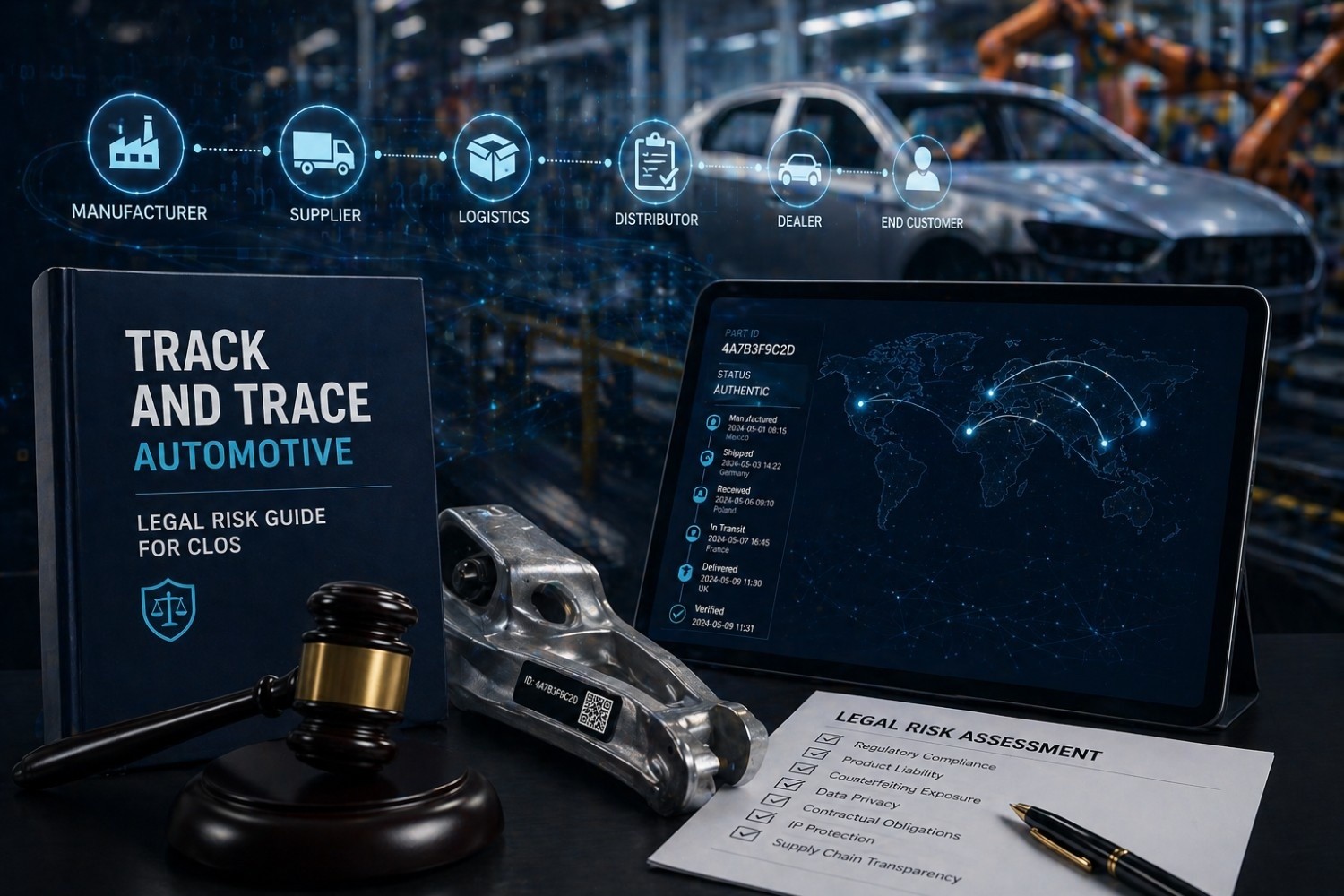
Track and Trace Automotive: The CLO's Guide to Counterfeit Parts Liability
Counterfeit automotive parts are no longer a supply-chain nuisance — they are a board-level legal emergency. The U.S. Department of Commerce estimates that counterfeit automotive parts cost the legitimate industry more than $12 billion annually in the United States alone, while the EUIPO has documented direct links between counterfeit spare parts and fatal road accidents across Europe. For Chief Legal Officers and General Counsel at OEMs and aftermarket suppliers, the question is no longer whether to act — it is which technologies create defensible legal positions and which leave your organization exposed. This explainer maps the regulatory landscape, compares track and trace automotive serialization against invisible cryptographic authentication, and provides the contractual language, procurement checklist, and evidentiary framework your legal team needs to reduce liability exposure today.
See How Ennoventure Strengthens Your Chain-of-Custody Evidence — Request a Demo
Ennoventure's invisible cryptographic authentication embeds covert, smartphone-verifiable signatures into automotive packaging at the artwork stage — zero manufacturing disruption, forensic-grade audit trails, and real-time intelligence for legal and compliance teams. See it in action with a vendor-focused walkthrough tailored to your supply chain.
Why Counterfeit Automotive Parts Are a Legal Emergency for CLOs
Product-liability exposure from counterfeit parts is escalating because courts in both the EU and US are increasingly willing to hold brand owners responsible for harm caused by parts bearing their trademarks — even when the counterfeiting occurred downstream in the supply chain. Failure to implement documented authentication measures is being treated by regulators and plaintiffs' counsel alike as evidence of negligence. The legal risk is compounded by the fact that counterfeit parts are virtually indistinguishable from genuine ones without forensic verification.
Real-world example #1: A European Tier 1 brake-pad supplier faced a multi-million-euro product-liability claim after counterfeit versions of its branded pads — lacking the correct friction compound — were installed in passenger vehicles across Germany and Poland. Because the supplier could not produce authenticated chain-of-custody records proving the parts in question were not genuine, the litigation dragged on for three years and resulted in a significant settlement, even though the supplier had not manufactured the counterfeit units.
Real-world example #2: According to EUIPO research, counterfeit automotive spare parts account for approximately 6% of total EU automotive parts sales by value — a figure that translates directly into warranty fraud, insurance disputes, and personal-injury litigation for legitimate brand owners.
Traditional Approach vs. Ennoventure Approach: Traditional legal risk management relies on post-incident investigation — pulling distribution records, interviewing channel partners, and commissioning laboratory analysis of suspect parts. This approach is slow, expensive, and rarely produces the timestamped, geo-tagged evidence that courts require. Ennoventure's invisible cryptographic authentication generates a continuous, tamper-evident scan log from the moment a part leaves the production facility, giving legal teams a ready-made evidentiary record before any incident occurs.
Common Mistake: Many legal teams assume that existing serialization systems provide sufficient protection because they create a digital record of part movement. In reality, serial numbers can be cloned or re-used by counterfeiters, and a database record alone does not prove that the physical part in a plaintiff's vehicle is the same unit that left the authorized factory.
Best Practice: GCs should require their supply-chain teams to layer invisible cryptographic authentication on top of existing serialization infrastructure. This dual-layer approach ensures that even if a serial number is compromised, the physical part carries an unforgeable cryptographic signature that can be verified in approximately 2.3 seconds by any smartphone — no dedicated app required.
Understanding Aftermarket Car Parts Liability
The aftermarket car parts segment is particularly vulnerable because parts change hands multiple times across distributors, wholesalers, and independent workshops before reaching the end consumer. Each handoff creates a potential entry point for counterfeit units and a gap in the chain-of-custody record. Legal teams must ensure that authentication obligations are contractually cascaded through every tier of the distribution network, not just direct suppliers.
Understanding the scale of legal exposure is only the first step. To build a defensible compliance posture, CLOs must also navigate a complex and rapidly evolving regulatory landscape that spans multiple jurisdictions, technical standards bodies, and enforcement agencies — each with distinct obligations and evidentiary expectations.
Regulatory and Standards Landscape: Jurisdiction-by-Jurisdiction Obligations
The regulatory framework governing automotive parts authentication is fragmented across jurisdictions, creating compliance complexity for global OEMs and aftermarket suppliers. In the EU, the Product Liability Directive and the EU Customs Regulation on counterfeit goods establish both civil and criminal liability for brand owners who fail to exercise due diligence. In the US, the FTC and CBP enforce anti-counterfeiting obligations under the Lanham Act and the Trade Facilitation and Trade Enforcement Act.
Real-world example #1: A US-based aftermarket parts distributor operating in the MENA region was subject to simultaneous enforcement actions by US CBP and UAE customs authorities after counterfeit oil filters bearing its brand were seized at Dubai port. The absence of a serialized, authenticated supply chain meant the distributor could not demonstrate that the seized units had not originated from its own distribution network — resulting in both a civil penalty and reputational damage with key retail partners.
Real-world example #2: GS1's automotive industry standards — including GTINs for part identification and GLNs for location tracking — are increasingly referenced in EU procurement regulations as baseline requirements for supply-chain traceability. Suppliers who cannot demonstrate GS1-compliant serialization risk disqualification from OEM approved-supplier lists.
Traditional Approach vs. Ennoventure Approach: Traditional compliance programs focus on meeting minimum serialization requirements — assigning GTINs, maintaining ERP records, and conducting periodic audits. While necessary, this approach is reactive and jurisdiction-specific. Ennoventure's platform is designed to interoperate with GS1-compliant serialization systems while adding a jurisdiction-agnostic cryptographic authentication layer that satisfies evidentiary standards across the EU, US, and emerging markets simultaneously.
Common Mistake: Legal teams often treat SAE AS5553 and ISO 12931 as aerospace-only standards irrelevant to automotive. In practice, both are increasingly cited in automotive procurement RFPs and supplier contracts as benchmarks for acceptable authentication methods, and failure to reference them in SLAs can leave contractual gaps that plaintiffs exploit.
Best Practice: Map your supplier contracts to the specific authentication requirements of each jurisdiction in which you operate. Include explicit references to SAE AS5553, ISO 12931, and GS1 standards in RFP language, and require suppliers to demonstrate compliance with at least Level 2 covert authentication as defined by ISO 12931.
EU and US Regulatory Divergence
The EU's General Product Safety Regulation (GPSR), effective 2024, imposes new traceability obligations on economic operators placing automotive parts on the EU market — including requirements for digital product passports in certain categories. US enforcement, by contrast, remains primarily customs- and trademark-based, with the FTC focusing on consumer deception. GCs operating across both jurisdictions should ensure their authentication technology generates audit records that satisfy both the EU's traceability documentation requirements and the US evidentiary standards for trademark-infringement litigation.
With the regulatory obligations mapped, legal teams need a clear-eyed comparison of the two dominant authentication technologies — serialization-based track and trace and invisible cryptographic authentication — evaluated specifically through the lens of legal defensibility, evidentiary value, and procurement risk.
Track and Trace Automotive vs Cryptographic Authentication: A Legal Comparison
The choice between serialization-based track and trace and cryptographic authentication is not binary — but understanding their distinct legal characteristics is essential for CLOs evaluating technology investments. Serialization excels at supply-chain visibility and regulatory compliance reporting. Cryptographic authentication excels at physical part verification and forensic evidence generation. The two technologies address different points of legal vulnerability.
Real-world example #1: A global automotive OEM in Southeast Asia deployed a GS1-compliant serialization system across its aftermarket parts network. When a product-liability claim arose involving allegedly counterfeit shock absorbers, the serialization database confirmed the part number had been issued — but could not confirm whether the physical unit in the plaintiff's vehicle was the genuine article or a cloned counterfeit bearing a copied serial number. The case settled unfavorably because no physical authentication evidence existed.
Real-world example #2: According to Ennoventure's Global Automotive Leader case study, a major OEM that deployed invisible cryptographic authentication was able to produce smartphone-verified scan records — timestamped and geo-tagged — that conclusively demonstrated counterfeit units had entered the supply chain through a specific unauthorized distributor in a defined geographic region, enabling targeted legal action within weeks.
Traditional Approach vs. Ennoventure Approach: Serialization provides a strong audit trail but is vulnerable to serial-number cloning and database manipulation. Invisible cryptographic authentication — as deployed by Ennoventure — embeds a mathematically unique, unforgeable signature into the part's packaging at the artwork stage. This signature cannot be replicated without the private cryptographic key, making it forensic-grade evidence of physical authenticity. The Ennoventure approach also requires no QR codes, holograms, or additional labels, eliminating the risk of label-swapping attacks that undermine visible authentication methods.
Common Mistake: Procurement teams often evaluate authentication technologies solely on cost-per-unit and integration complexity, without consulting legal teams on evidentiary requirements. This results in systems that satisfy operational needs but fail to generate the chain-of-custody documentation required for litigation or regulatory defense.
Best Practice: Involve your GC or CLO in technology selection from the outset. Require vendors to provide a written evidentiary framework document explaining how their authentication records satisfy chain-of-custody requirements in your key jurisdictions. Review Ennoventure's detailed comparison of cryptographic vs serialization approaches for a vendor-neutral framework.
Evidentiary Characteristics: What Courts Actually Need
For authentication evidence to be admissible and persuasive in litigation, it must satisfy three criteria: integrity (the record cannot have been altered after the fact), specificity (the record links a specific physical unit to a specific time, place, and actor), and verifiability (an independent expert can reproduce the verification process). Ennoventure's mobile verification platform generates records that satisfy all three criteria — cryptographically signed scan logs that are tamper-evident, geo-tagged, and independently reproducible using standard smartphone hardware.
Download the Legal Brief: Track-and-Trace vs Cryptographic Authentication (PDF)
Get Ennoventure's practitioner-ready legal brief mapping serialization and cryptographic authentication capabilities to chain-of-custody requirements, admissibility standards, and product-liability exposure — formatted for GC review and board presentation.
The technology comparison clarifies what is possible — but translating technical capabilities into legal protection requires explicit mapping to chain-of-custody doctrine, product-liability frameworks, and the contractual language that binds suppliers to enforceable authentication obligations.
Legal Implications: Chain-of-Custody, Admissibility, and Product-Liability Mapping
Chain-of-custody in the automotive context means documenting the authenticated movement of a specific physical part from manufacturer to end user in a way that is tamper-evident and independently verifiable. Without this documentation, brand owners cannot rebut plaintiff allegations that a defective part was genuine, and cannot pursue indemnification claims against the supplier who introduced the counterfeit unit.
Real-world example #1: A North American OEM successfully defended a product-liability claim involving allegedly defective airbag inflators by producing Ennoventure-generated scan records showing that the specific units in the plaintiff's vehicles had been authenticated at the point of installation by an authorized dealer — and that a parallel batch of unverified units had been flagged as suspect by the intelligence dashboard three months earlier, triggering a targeted recall of only the affected distribution channel.
Real-world example #2: ZF Aftermarket's liability guidance explicitly warns workshops that installing counterfeit parts — even unknowingly — can expose them to full product-liability claims under EU law. This downstream liability pressure creates a commercial incentive for workshops to demand authenticated parts, strengthening the OEM's negotiating position when requiring suppliers to adopt authentication technology.
Traditional Approach vs. Ennoventure Approach: Traditional product-liability defense relies on paper-based certificates of conformity and ERP shipping records — documents that are easily forged and difficult to link to a specific physical unit. Ennoventure's approach generates a cryptographically signed, smartphone-verifiable record for each individual part, creating an unbroken digital chain from factory to field that is far more persuasive to courts and regulators than paper documentation.
Common Mistake: GCs often draft indemnification clauses that require suppliers to "maintain adequate anti-counterfeit measures"without specifying what "adequate"means in technical terms. This vagueness makes indemnification claims difficult to enforce when a supplier argues that its existing hologram or QR-code system was sufficient.
Best Practice: Define "adequate anti-counterfeit measures"in supplier contracts by reference to specific technical standards (ISO 12931 Level 2 or above, GS1-compliant serialization, and covert cryptographic authentication) and require suppliers to provide quarterly audit-log exports as evidence of ongoing compliance. Ennoventure's platform supports automated audit-log exports in formats compatible with standard legal discovery processes.
Recommended Contractual Language for RFPs and SLAs
Legal teams should include the following provisions in anti-counterfeit technology RFPs and supplier SLAs: (1) Authentication Standard Clause — "Supplier shall implement covert cryptographic authentication meeting ISO 12931 Level 2 or above on all parts supplied under this agreement"; (2) Audit-Log Retention Clause — "Vendor shall retain tamper-evident scan logs for a minimum of seven years and provide exports within 48 hours of legal request"; (3) Indemnification Clause — "Supplier shall indemnify Brand Owner for all losses arising from authentication system failures that result in counterfeit parts entering the authorized supply chain."See Ennoventure's invisible authentication solution page for technical specifications to reference in these clauses.
Contractual protections are only as strong as the technology they reference. The next critical question for CLOs is whether deploying advanced authentication technology requires significant manufacturing investment — and the answer, with the right vendor, is no.
Implementation Considerations: Deployment Without Manufacturing Disruption
One of the most common objections legal and procurement teams encounter when proposing advanced authentication technology is resistance from manufacturing and operations teams who fear production-line disruption, capital expenditure, and integration complexity. These concerns are legitimate — but they are addressed by Ennoventure's artwork-stage deployment model, which requires no changes to physical production lines.
Real-world example #1: A European aftermarket parts manufacturer with 14 production facilities across three countries deployed Ennoventure's invisible cryptographic authentication across its entire product range in under 90 days — without halting a single production line — by integrating the cryptographic signature generation into its existing pre-press artwork workflow. The total capital expenditure was limited to software licensing and a one-time artwork integration fee.
Real-world example #2: Ennoventure's Automotive Anti-counterfeiting Guide documents that organizations deploying invisible authentication alongside existing GS1-compliant serialization systems achieve full interoperability without replacing or modifying their existing track-and-trace infrastructure — a critical consideration for OEMs with multi-year ERP investment cycles.
Traditional Approach vs. Ennoventure Approach: Traditional authentication upgrades — adding holograms, RFID tags, or new label formats — require physical changes to packaging lines, new materials procurement, and supplier re-qualification. Ennoventure's invisible cryptographic approach is embedded at the digital artwork stage, meaning the only change is in the pre-press file — invisible to the production line, invisible to counterfeiters, and verifiable by any smartphone in the field.
Common Mistake: Procurement teams often issue RFPs for authentication technology without including a "zero-disruption deployment"requirement, inadvertently selecting solutions that require expensive line modifications and extended implementation timelines that delay legal protection.
Best Practice: Include a "deployment timeline and manufacturing impact assessment"requirement in all authentication technology RFPs. Require vendors to demonstrate that their solution can be deployed without halting production and provide a reference customer in the automotive sector who can validate the deployment experience.
Interoperability with Existing Serialization Systems
For OEMs and Tier 1 suppliers already operating GS1-compliant serialization, the priority is additive authentication — not replacement. Ennoventure's platform is designed to layer invisible cryptographic signatures on top of existing serialization infrastructure, preserving the supply-chain visibility benefits of track and trace while adding the physical authentication and forensic evidence capabilities that serialization alone cannot provide. This interoperability protects existing technology investments and accelerates time-to-compliance for legal teams facing regulatory deadlines.
Theory and technology only matter when they translate into concrete action. The following section provides a practical checklist for General Counsel, grounded in a real-world case example, to move from awareness to implementation.
Case Example and GC Action Checklist
Consider a global automotive OEM with aftermarket operations in the EU, US, and Southeast Asia. Its legal team identified three specific liability vectors: (1) counterfeit brake components bearing its trademark causing personal-injury claims; (2) grey-market diversion of genuine parts into unauthorized channels, voiding warranty obligations; and (3) inability to produce authenticated chain-of-custody records in ongoing litigation. Each vector required a different but complementary response.
Real-world example #1: After deploying Ennoventure's invisible cryptographic authentication and intelligence dashboard, the OEM's legal team was able to identify a specific distributor in Malaysia responsible for introducing counterfeit brake pads into the authorized network — based on geo-tagged scan anomalies flagged by the intelligence layer. The distributor was terminated within 30 days, and the authenticated scan records were used to support a successful trademark-infringement injunction in Malaysian courts.
Real-world example #2: The same OEM used Ennoventure's audit-log exports to demonstrate to its product-liability insurer that it had implemented ISO 12931-compliant authentication across 94% of its aftermarket SKUs — resulting in a 15% reduction in its annual product-liability insurance premium, directly offsetting the cost of the authentication technology deployment.
Traditional Approach vs. Ennoventure Approach: Without a real-time intelligence layer, the OEM's legal team would have relied on periodic manual audits and reactive investigation — typically taking three to six months to identify a counterfeit entry point. Ennoventure's approach compressed this to days, enabling proactive enforcement rather than reactive litigation.
Common Mistake: GCs often treat authentication technology deployment as a one-time project rather than an ongoing compliance program. Without regular review of scan-log anomalies and periodic supplier re-audits, the intelligence value of the platform degrades over time.
Best Practice: Establish a quarterly authentication compliance review process involving legal, supply chain, and quality assurance teams. Use Ennoventure's intelligence dashboard to set automated alerts for scan-frequency anomalies, geographic outliers, and authentication failure rates that exceed defined thresholds.
GC Action Checklist: Five Steps to Reduce Counterfeit Liability Now
Step 1 — Audit your current supplier contracts for authentication obligations and identify gaps against ISO 12931 and SAE AS5553 benchmarks. Step 2 — Issue an RFP for invisible cryptographic authentication that specifies zero-manufacturing-disruption deployment and GS1 interoperability. Step 3 — Update indemnification and SLA clauses to reference specific technical standards and audit-log retention requirements. Step 4 — Deploy Ennoventure's intelligence dashboard to generate real-time scan data for ongoing chain-of-custody documentation. Step 5 — Brief your product-liability insurer on your authentication program to negotiate premium adjustments. For a full procurement checklist, visit Ennoventure's Anti-counterfeiting Beyond Serialization guide.
Frequently Asked Questions
What is track and trace in the automotive industry?
Track and trace in the automotive industry refers to serialization-based systems that assign unique identifiers to parts and record their movement through the supply chain. These systems create a digital audit trail from manufacturer to end user. However, track-and-trace alone cannot verify physical part authenticity at the point of installation or investigation. Ennoventure's invisible cryptographic authentication complements serialization by embedding covert, smartphone-verifiable signatures directly into part packaging — providing forensic-grade proof that no serial number alone can deliver.
How does counterfeit automotive parts liability affect OEMs legally?
OEMs face product-liability exposure when counterfeit parts enter their supply chain and cause accidents, warranty claims, or regulatory violations. Courts in the EU and US have increasingly held brand owners responsible for harm caused by parts bearing their trademarks, even when counterfeiting occurred downstream. Establishing a documented chain-of-custody with authenticated verification records is critical to mounting a credible defense. Ennoventure's intelligence layer generates timestamped, geo-tagged scan logs that can serve as admissible evidence in litigation.
What is SAE AS5553 and why does it matter for legal teams?
SAE AS5553 is an aerospace and defense standard addressing counterfeit electronic parts, widely referenced as a benchmark for anti-counterfeit procurement requirements in high-stakes supply chains including automotive. Legal teams use it to define supplier obligations and acceptable authentication methods in RFPs and SLAs. Understanding SAE AS5553 helps GCs draft contractual clauses that shift liability to non-compliant suppliers. See Ennoventure's glossary entry on SAE AS5553 for a plain-language breakdown applicable to automotive procurement.
What is the difference between serialization and cryptographic authentication for automotive parts?
Serialization assigns a unique number to each part and tracks it through a database — it is strong for supply-chain visibility but vulnerable to cloning if counterfeiters replicate the serial number. Cryptographic authentication embeds an invisible, mathematically unique signature into the part's packaging or label that cannot be copied without the private key. Ennoventure's approach combines both layers: serialization provides the audit trail while invisible cryptographic signatures provide irrefutable physical proof of authenticity, verifiable by any smartphone in approximately 2.3 seconds without a dedicated app.
Can invisible authentication evidence be used in court?
Yes — when properly documented, invisible cryptographic authentication records can support admissibility in civil and criminal proceedings. The key requirements are a tamper-evident audit log, a clear chain-of-custody record linking the scan event to the specific part and location, and expert testimony on the cryptographic methodology. Ennoventure's platform generates timestamped, geo-tagged scan records that satisfy these evidentiary requirements and can be exported for use in litigation or regulatory investigations.
What contractual clauses should legal teams include when procuring anti-counterfeit technology?
GCs should require vendors to include: (1) an SLA guaranteeing audit-log retention for a minimum of seven years; (2) indemnification clauses covering liability arising from authentication system failures; (3) interoperability warranties confirming compatibility with existing serialization infrastructure; and (4) forensic-evidence support obligations requiring the vendor to provide expert testimony or technical documentation in litigation. Ennoventure's procurement checklist maps these clauses to specific technology capabilities including invisible authentication and intelligence dashboards.
How does the EUIPO define liability for counterfeit automotive spare parts?
The EUIPO has highlighted that counterfeit automotive spare parts — including brake pads, airbags, and filters — pose direct safety risks and expose distributors, workshops, and brand owners to civil and criminal liability under EU trademark and product-safety law. The EUIPO's guidance emphasizes that even unknowing distributors can face liability if they fail to implement reasonable due-diligence measures. Deploying authenticated track-and-trace systems is increasingly recognized as a due-diligence standard that can mitigate exposure.
Does implementing cryptographic authentication disrupt automotive manufacturing lines?
No — Ennoventure's invisible cryptographic authentication is embedded at the artwork or pre-press stage, meaning no changes to physical production lines, no additional labels, and no QR codes or holograms are required. The signature is integrated into existing packaging artwork before printing, making it completely transparent to manufacturing operations. This zero-disruption deployment model is a key differentiator for OEMs and aftermarket suppliers evaluating anti-counterfeit technology without operational risk.
What is ISO 12931 and how does it relate to automotive anti-counterfeiting?
ISO 12931 is an international standard that defines performance criteria for authentication solutions used to combat counterfeiting. It provides a framework for evaluating whether a given technology — such as serialization, holograms, or cryptographic signatures — meets minimum requirements for covertness, security level, and verifiability. Legal teams can reference ISO 12931 in supplier contracts to establish objective benchmarks for acceptable authentication methods. Ennoventure's invisible cryptographic approach is designed to meet the covert, Level 3 authentication criteria described in the standard.
How can a GC use authentication data to accelerate a counterfeit investigation?
Authentication scan data — including timestamps, GPS coordinates, device identifiers, and scan frequency anomalies — can dramatically accelerate investigations by pinpointing where in the supply chain counterfeit parts entered. This intelligence layer allows legal teams to identify specific distributors, geographies, or time windows associated with counterfeit activity, enabling targeted enforcement actions rather than broad, costly investigations. Ennoventure's intelligence dashboard surfaces these patterns in real time, giving GCs actionable data within days rather than months.
Are GS1 standards compatible with cryptographic authentication systems?
Yes — GS1 standards for automotive parts traceability, including GTINs and GLNs, are fully compatible with cryptographic authentication overlays. Ennoventure's platform is designed to interoperate with existing GS1-compliant serialization systems, allowing organizations to layer invisible authentication on top of their current track-and-trace infrastructure without replacing it. This interoperability is critical for OEMs and Tier 1 suppliers who have already invested in GS1-based supply-chain visibility.
What is the estimated financial impact of counterfeit automotive parts on OEMs?
The U.S. Department of Commerce estimates that counterfeit automotive parts cost the legitimate industry more than $12 billion annually in the US market alone. Beyond direct financial losses, OEMs face escalating product-liability claims and regulatory penalties as enforcement agencies in the EU and US intensify scrutiny of supply-chain due diligence. Proactive deployment of authenticated track-and-trace systems is increasingly viewed by insurers and regulators as a prerequisite for demonstrating reasonable care.
Conclusion
Counterfeit automotive parts represent one of the most significant and underappreciated legal risks facing OEMs and aftermarket suppliers today. The combination of escalating regulatory enforcement, expanding product-liability doctrine, and increasingly sophisticated counterfeiting operations means that legal teams can no longer rely on serialization alone. The path to a defensible legal posture requires:
Layering invisible cryptographic authentication on top of existing track-and-trace systems to generate forensic-grade chain-of-custody evidence
Updating supplier contracts with specific technical standards references (ISO 12931, SAE AS5553, GS1) and enforceable audit-log retention obligations
Deploying a real-time intelligence layer that surfaces counterfeit entry points before they become litigation events
Engaging your product-liability insurer with documented authentication compliance to negotiate premium reductions
The window to act proactively — before the next product-liability claim lands — is now. Explore Ennoventure's full automotive aftermarket anti-counterfeit solution and take the first step toward a legally defensible supply chain today.
Schedule Your Compliance & Liability Assessment with Ennoventure
Ennoventure's legal and technical team will review your current authentication posture, map gaps against ISO 12931 and SAE AS5553 requirements, and provide a tailored roadmap for deploying invisible cryptographic authentication without disrupting your manufacturing operations. No obligation — just clarity on where your legal exposure lies and how to close it.
FAQs
What is the difference between Digital Brand Protection and Invisible Authentication?
Digital Brand Protection covers online surfaces — marketplaces, social platforms, forums, and news. Invisible Authentication secures the physical product and its packaging. Together they form a complete protection stack: digital intelligence flags threats, and physical authentication provides legal-grade proof.
Do I need to use both Online Brand Protection and Chirper?
Both can be used independently or as a combined Digital Brand Protection suite. Brands typically start with the surface where their risk is highest and expand as needs grow.
Which marketplaces and social platforms are covered?
Online Brand Protection covers 50+ global marketplaces including Amazon, Flipkart, Alibaba, AliExpress, Tmall, Walmart, Shopee, Lazada, Mercado Libre, JD.com, and eBay. Chirper monitors Reddit, X, news sites, forums, review sites, trade publications, and brand communities.
How quickly can threats be detected and acted on?
Marketplace takedowns are initiated within 24 hours of threat classification. Social conversation alerts arrive in under one hour from when a relevant discussion begins.
Does this require integration with our internal systems?
No technical integration is required. You provide your brand keywords, product names, and target marketplaces. Everything runs through a cloud dashboard.
Which industries does Digital Brand Protection serve?
Digital Brand Protection is built for pharmaceuticals, consumer goods, luxury, FMCG, automotive aftermarket, electronics, and specialty chemicals — industries where pricing discipline, authenticity, and brand trust are mission-critical.