Pharmaceutical Track and Trace Implementation Guide 2024
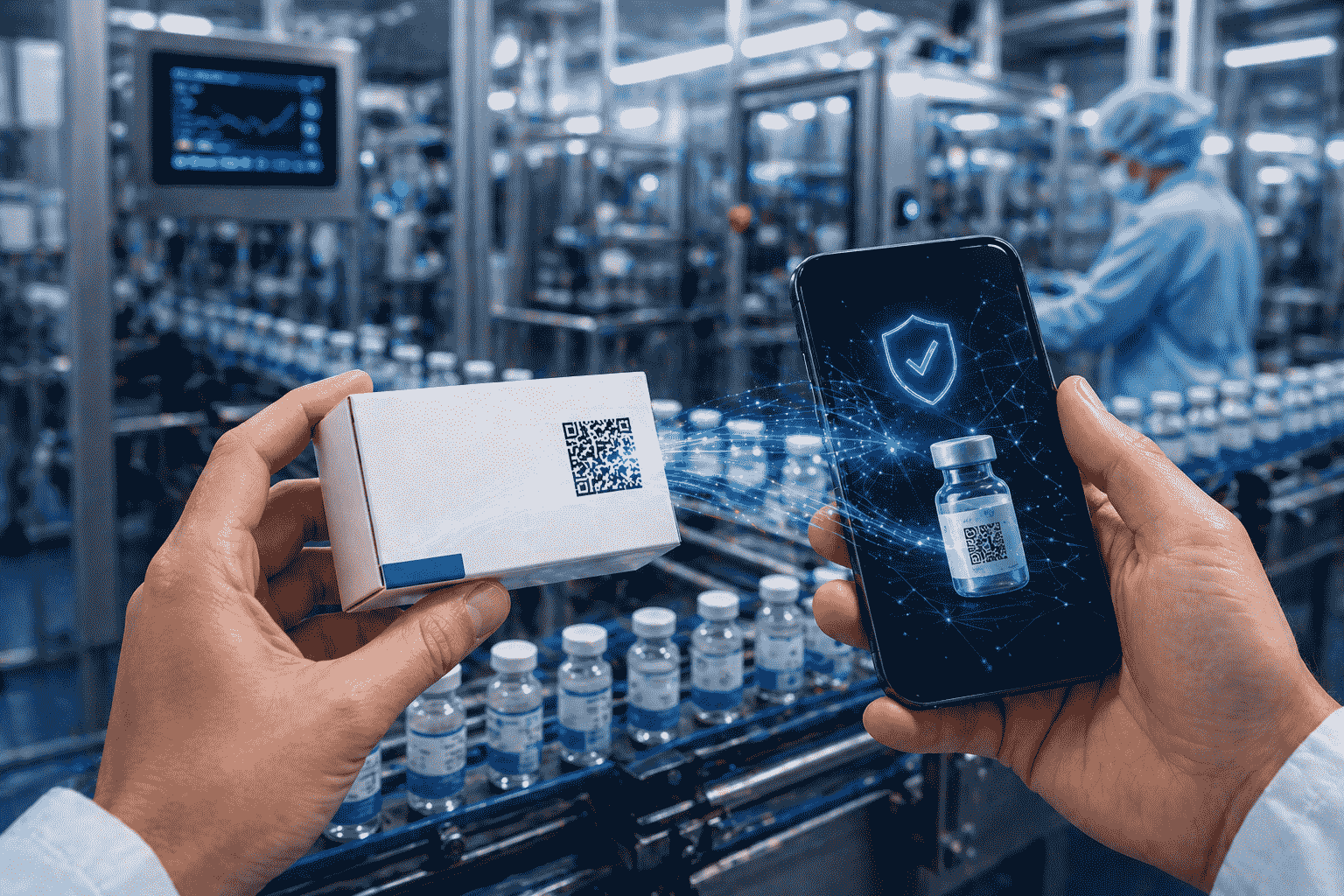
Pharmaceutical Track and Trace Implementation Guide: Integrate Invisible Cryptographic Authentication with Serialization for Zero Line Disruption
Regulatory deadlines are no longer on the horizon they are here. The U.S. Drug Supply Chain Security Act (DSCSA) and the EU Falsified Medicines Directive (EU FMD) now mandate unit-level traceability and electronic verification across every link in the pharmaceutical supply chain.
For Heads of Supply Chain and Operations, this means navigating a complex intersection of packaging-line OT systems, enterprise IT platforms, trading-partner data exchange, and an ever-present pressure to keep lines running. Most implementation guides stop at serialization.
This guide goes further: it shows you how to layer invisible cryptographic authentication on top of your existing serialization infrastructure — adding forensic-grade product verification that works in approximately 2.3 seconds on any smartphone, with no app required and zero packaging-line disruption.
Whether you are beginning your DSCSA implementation or hardening an existing EU FMD serialization deployment, this operational playbook gives you the checklists, integration architecture, partner onboarding timelines, and KPI models you need to move from compliance to competitive advantage. Explore Ennoventure's full pharmaceutical and healthcare solutions to see how each component fits together.
Download the Full Pharmaceutical Track-and-Trace Implementation Guide (Free PDF)
Get the complete operational playbook — including line-readiness checklists, EPCIS integration diagrams, partner onboarding timelines, and a KPI dashboard template — in a single gated PDF built for supply chain decision-makers. Used by operations teams across regulated markets to accelerate DSCSA and EU FMD go-live.
Regulatory Context: DSCSA and EU FMD Unit-Level Traceability Requirements
Supply chain leaders face a dual regulatory burden that is technically distinct but operationally simultaneous.
DSCSA requires U.S. manufacturers, wholesalers, and dispensers to exchange standardized transaction data (T3 documents) and support electronic interoperable tracing at the unit level, with full enforcement milestones active as of late 2024 per the FDA's DSCSA guidance.
EU FMD mandates a 2D Data Matrix code and tamper-evident feature on every prescription pack, verified against national medicines verification systems (NMVS) at the point of dispense. Non-compliance risks product seizure, market withdrawal, and significant reputational damage.
A large generic manufacturer in Germany, deploying EU FMD serialization across six packaging lines, discovered mid-rollout that its ERP master data used a different GTIN format than its serialization platform — causing a three-week line stoppage and €400,000 in delayed shipments. This is not an edge case; it is the norm when regulatory timelines compress implementation windows.
According to a PMC realist review of pharmaceutical track-and-trace implementations, master data inconsistency and OT/IT interface failures are the two most frequently cited root causes of go-live delays across both DSCSA and EU FMD programs.
Traditional Approach: Most manufacturers treat DSCSA and EU FMD as separate compliance projects with separate vendors, leading to duplicated infrastructure, inconsistent data models, and no shared intelligence layer.
Ennoventure's Approach: A unified implementation that meets both regulatory frameworks simultaneously, with an invisible cryptographic layer that adds authentication capability beyond what either regulation requires — future-proofing your investment.
Common Mistake: Treating regulatory compliance as the finish line. Serialization that meets DSCSA or EU FMD minimum requirements does not protect against sophisticated counterfeiters who can clone 2D barcodes. Compliance is the floor, not the ceiling.
Best Practice: Map your regulatory obligations across all markets in a single master compliance matrix before selecting technology. Identify overlapping data elements (GTIN, batch, expiry, serial number) that can be managed in a single master data repository, reducing reconciliation overhead by up to 60%.
DSCSA vs. EU FMD: Key Technical Differences
DSCSA is a supply-chain-wide transaction tracing model; EU FMD is a point-of-dispense verification model. DSCSA uses EPCIS event messaging for custody transfer; EU FMD uses NMVS API calls for pack commissioning and decommissioning. Both use GS1 standards as the data backbone — see the GS1 EPCIS standard for the authoritative technical specification.
Ennoventure's cryptographic signature technology is designed to sit alongside both frameworks without requiring changes to your existing EPCIS or NMVS integration.
With the regulatory landscape mapped, the next critical step is assessing whether your manufacturing environment is actually ready to support unit-level traceability at production speed. Many programs fail not because of technology gaps but because of overlooked operational prerequisites — from OT network latency to label master data hygiene. The following checklist gives you a structured pre-deployment framework to identify and resolve these issues before they become line-stoppage events.
Operational Readiness Checklist: Line Impact, OT/IT Interfaces, and Master Data
Operational readiness is the most under-resourced phase of any pharmaceutical serialization project. Line-level serialization controllers must communicate with enterprise serialization platforms at speeds that match your packaging line's output — typically 200–400 packs per minute — without introducing reject rates above 0.5%. Any latency in the OT/IT interface translates directly into line downtime and batch rework costs.
A mid-sized U.S. contract manufacturer deploying DSCSA serialization across four lines found that its existing OT network switches could not sustain the required throughput for real-time serial number requests, resulting in a 12% reject rate during initial validation runs. After upgrading network infrastructure and implementing local serial number buffering, reject rates dropped to 0.2% within two weeks.
The WHO estimates that up to 10% of medicines in low- and middle-income countries are substandard or falsified, per the WHO substandard and falsified medicines fact sheet — underscoring that operational readiness is not just a compliance issue but a patient safety imperative.
Traditional Approach: Vendors deliver serialization hardware and software, then leave OT/IT integration to the manufacturer's internal IT team — often without documented interface specifications. Ennoventure's Approach: Pre-deployment OT/IT interface mapping is included in the implementation engagement, with documented data flow diagrams and latency benchmarks before any hardware is installed.
Common Mistake: Skipping master data hygiene before go-live. GTIN mismatches between ERP and the serialization platform are the single most common cause of EPCIS event failures. Audit every product master record before deployment.
Best Practice: Run a four-week parallel operation period where serialization events are generated and validated against EPCIS without affecting production release decisions. This surfaces integration issues in a controlled environment and builds operator confidence before full cutover.
Pre-Deployment Testing Protocol
Your pre-deployment test plan should cover: (1) serial number pool provisioning and depletion simulation, (2) EPCIS event generation at 110% of maximum line speed, (3) reject-handling and reprint workflows, and (4) ERP goods-receipt integration for aggregation data.
Ennoventure's anti-counterfeit solution includes pre-built test scripts for each scenario, reducing test plan authoring time by approximately 50% compared to building from scratch.
Once your lines are operationally ready, the integration architecture becomes the critical path. Connecting your serialization subsystem to ERP, WMS, and EPCIS repositories — while managing partner data exchange and exception handling — requires a disciplined playbook. The next section provides the integration sequence and decision points that keep your program on schedule and your trading partners synchronized.
Integration Playbook: Connecting Serialization to ERP, WMS, and EPCIS
The integration layer is where most pharmaceutical serialization programs accumulate technical debt. A serialization subsystem that cannot reliably post EPCIS events to your 3PL's repository, or that loses aggregation data during an ERP goods-receipt transaction, creates compliance gaps that are expensive to remediate after go-live.
A European specialty pharma company integrating its serialization platform with SAP ERP and a third-party EPCIS repository discovered that its WMS was stripping lot-number leading zeros during goods-receipt processing — causing EPCIS event mismatches that took six weeks to diagnose and fix post-launch.
Traditional Approach: Point-to-point integrations built by each vendor independently, with no shared data model or exception-handling protocol. Ennoventure's Approach: A middleware-agnostic integration layer that maps serialization events to your existing ERP/WMS data model, with a centralized exception queue and automated retry logic built in from day one.
Common Mistake: Assuming your EPCIS repository vendor handles partner connectivity. In practice, each trading partner requires individual onboarding, credential provisioning, and message format validation — plan for 8–16 weeks per major partner.
Best Practice: Implement asynchronous EPCIS event posting so that line operations are never blocked waiting for a repository acknowledgment. Use a local event buffer with a guaranteed-delivery queue, and monitor queue depth as a leading indicator of integration health.
Exception Handling and Rollback Workflows
Define three exception tiers before go-live: (1) auto-retry (format errors, timeouts), (2) manual review (master data mismatches, duplicate serial numbers), and (3) regulatory escalation (verification failures at point of dispense). Each tier needs a documented owner, SLA, and resolution workflow.
Ennoventure's brand protection intelligence platform provides a unified exception dashboard across all tiers, with real-time alerting to prevent compliance gaps from accumulating undetected.
With your serialization and integration infrastructure in place, you are ready to add the layer that transforms compliance into competitive advantage: invisible cryptographic authentication. This section explains how Ennoventure's approach works technically, how it integrates with your existing line without disruption, and how smartphone verification workflows operate in the field — including offline environments.
Invisible Cryptographic Authentication: Implementation and Smartphone Verification
Standard serialization tells you where a pack has been. Invisible cryptographic authentication tells you whether the pack is genuine — a distinction that matters enormously when counterfeiters can clone a 2D barcode in hours. Ennoventure embeds a unique cryptographic signature directly into the printed artwork of each pack at the pre-press stage, invisible to the naked eye and impossible to replicate without the private key.
A branded pharmaceutical manufacturer in Southeast Asia deployed invisible authentication across its top-five SKUs after discovering that counterfeit versions of its oncology product — carrying cloned serial numbers — had entered the supply chain in three markets. Within 90 days of deployment, field investigators using smartphone verification identified 14 distinct counterfeit batches that would have been invisible to serialization-only checks.
Traditional Approach: Holograms, color-shifting inks, and overt security labels add cost, require packaging redesign, and are increasingly replicated by sophisticated counterfeiters. QR codes are scannable but clonable.
Ennoventure's Approach: Invisible authentication requires no packaging redesign, no additional label, and no hardware on the packaging line the signature is embedded at the artwork stage, making it truly zero-disruption.
Common Mistake: Deploying overt authentication features (holograms, QR codes) as the primary anti-counterfeiting measure. These are visible to counterfeiters and provide a roadmap for replication. Invisible features that are mathematically verifiable are significantly harder to defeat.
Best Practice: Integrate invisible authentication into your artwork approval workflow as a standard step, alongside color proofing and regulatory text review. This ensures every new SKU and every packaging refresh automatically carries the cryptographic layer with no additional project overhead.
Smartphone Verification Workflow
Field verification using Ennoventure's mobile verification technology requires no app download. A standard smartphone camera captures the pack image; the cryptographic signature is extracted and verified against the private key in approximately 2.3 seconds, returning a pass/fail result with batch and origin metadata.
Offline verification is supported results sync to the intelligence platform when connectivity is restored — making this workflow viable in cold-chain environments, remote pharmacies, and emerging markets where network reliability is inconsistent.
Request a Technical Demo: See Ennoventure Integrate with Your Existing Serialization Line
See exactly how invisible cryptographic authentication layers onto your current serialization infrastructure — with a live walkthrough of the OT integration architecture, smartphone verification workflow, and EPCIS exception handling. Demos are tailored to your line configuration and regulatory market.
Partner Onboarding and Testing: Timelines, Edge Cases, and Rollback Workflows
Partner onboarding is consistently the longest critical-path item in any DSCSA or EU FMD program. Trading partners vary enormously in their technical maturity: a Tier 1 wholesaler may have a fully operational EPCIS 2.0 endpoint; a regional distributor may still be exchanging paper-based transaction records. Your onboarding program must accommodate both extremes without delaying your own compliance go-live.
A U.S. pharmaceutical distributor managing onboarding for 47 downstream dispensing partners found that 30% required manual EPCIS message format remediation during testing — adding an average of six weeks per affected partner to the program timeline.
Traditional Approach: Onboarding is managed ad hoc, with each partner receiving a generic connectivity guide and a test environment URL. Edge cases (duplicate serial numbers, EPCIS schema version mismatches, timezone handling errors) are discovered during production go-live rather than testing.
Ennoventure's Approach: A structured partner onboarding playbook with pre-built test scripts covering the 12 most common interoperability edge cases, a tiered rollout schedule prioritizing high-volume partners, and a documented rollback procedure for each integration point.
Common Mistake: Starting partner onboarding too late. Given 8–16 week timelines for major partners, onboarding must begin at least six months before your target go-live date to avoid a compliance gap.
Best Practice: Classify partners into three tiers by volume and technical maturity. Onboard Tier 1 partners first (highest volume, most technically capable), use their go-live learnings to refine the playbook, then cascade to Tier 2 and Tier 3. This reduces total program risk and accelerates the overall timeline.
With your technology deployed and partners onboarded, the final imperative is demonstrating business value to your CFO and executive team. The following section provides ROI model frameworks, cost-avoidance scenarios, and the KPI dashboard structure that supply chain leaders need to sustain investment in serialization and authentication programs over the long term.
Business Case and KPIs: ROI Models and Supply Chain Dashboards
Serialization and authentication programs are significant capital investments, and supply chain leaders are increasingly required to justify them in financial terms beyond regulatory compliance. The good news: the ROI case is strong when modeled correctly, and most programs reach break-even within 18–36 months.
A mid-sized European generic manufacturer that deployed combined serialization and invisible cryptographic authentication reported a 40% reduction in confirmed counterfeit incidents within 12 months, translating to an estimated €2.1M in avoided brand damage and regulatory penalty costs. Recall isolation speed — the time from a quality alert to full lot quarantine across the supply chain — improved from an average of 72 hours to under 8 hours, reducing potential liability exposure significantly.
Traditional Approach: ROI is modeled solely on compliance cost-avoidance (penalty risk reduction), which is difficult to quantify and unconvincing to finance teams. Ennoventure's Approach: A multi-dimensional ROI model that captures compliance cost-avoidance, counterfeit incident reduction, recall speed improvement, grey-market diversion loss recovery, and intelligence value — all tied to measurable supply chain KPIs.
Common Mistake: Building the ROI case after the investment decision. Model ROI before vendor selection so that KPI baselines are established and post-go-live performance can be measured against a credible benchmark.
Best Practice: Establish a KPI dashboard at go-live covering: serialization line uptime (target >99%), EPCIS event error rate (target <0.5%), average verification response time, recall isolation speed, and counterfeit incident rate by market. Review monthly with supply chain, QA, and finance stakeholders.
Ennoventure's brand protection intelligence platform provides this dashboard out of the box, with anomaly detection alerts for diversion and counterfeit patterns.
Cost-Avoidance Scenario Modeling
Model three scenarios for your CFO: (1) a product recall without serialization (average cost: $10M–$50M for a mid-tier product, per industry benchmarks); (2) a recall with serialization but without authentication (lot isolation in 24–72 hours, significant cost reduction); and (3) a recall with serialization plus invisible authentication (lot isolation in under 8 hours, counterfeit units identified and excluded from recall scope, maximum cost avoidance).
The incremental cost of adding invisible authentication to an existing serialization program is typically less than 2% of total program cost — making the ROI case straightforward.
Frequently Asked Questions
What is a pharmaceutical track and trace implementation guide?
A pharmaceutical track and trace implementation guide is a structured operational playbook that walks supply chain leaders through every step of deploying serialization, unit-level traceability, and verification systems to meet regulations like DSCSA and EU FMD. It covers technology selection, line integration, partner onboarding, and KPI measurement.
Ennoventure's approach goes further by layering invisible cryptographic authentication on top of standard serialization, adding forensic-grade verification capability without disrupting existing packaging lines. Use this guide as your master checklist from pre-deployment planning through go-live and continuous monitoring.
What are the key DSCSA implementation requirements for manufacturers?
Under DSCSA, U.S. manufacturers must assign a unique product identifier to every saleable unit, maintain transaction data (T3 documents), and support electronic interoperable tracing. Systems must respond to verification requests within 24 hours and support product investigations. Ennoventure's pharmaceutical serialization software integrates directly with EPCIS repositories and ERP systems to automate T3 data exchange and verification responses.
Start by auditing your current serialization infrastructure against the FDA's DSCSA guidance before selecting additional authentication layers.
How does EU FMD serialization differ from DSCSA?
EU FMD requires a 2D Data Matrix code and tamper-evident feature on every prescription medicine pack, verified at the point of dispensing against a national medicines verification system. DSCSA focuses on the full supply chain transaction history, while EU FMD is primarily a point-of-dispense verification model. Both regulations demand unit-level traceability implementation, but the technical architecture and data exchange partners differ significantly.
Ennoventure's invisible authentication layer is compatible with both frameworks, adding a cryptographic signature that works alongside the mandated 2D code without requiring packaging redesign.
What does unit-level traceability implementation mean in practice?
Unit-level traceability means every individual saleable pack carries a unique identifier that can be tracked and verified at each custody transfer point — from manufacturer to wholesaler to pharmacy. In practice, this requires serialization hardware on packaging lines, middleware to manage serial number pools, and integration with EPCIS event repositories.
A common mistake is treating unit-level traceability as a pure IT project; it is equally an OT challenge requiring line-speed validation and reject-handling workflows. Ennoventure's solution embeds cryptographic signatures at the artwork stage, meaning the authentication layer is applied before the pack even reaches the line.
How can invisible cryptographic authentication complement serialization?
Invisible cryptographic authentication embeds a machine-readable, human-invisible signature directly into the printed artwork of a pack — no QR code, hologram, or additional label required. This signature is mathematically unique to each unit and can be verified in approximately 2.3 seconds using any standard smartphone camera, with no app download needed.
While serialization tracks custody events, invisible authentication provides forensic-grade proof of product origin that cannot be cloned or replicated by counterfeiters. Learn more about Ennoventure's invisible authentication technology and how it layers onto existing serialization infrastructure.
What OT/IT integration challenges should I anticipate during serialization deployment?
The most common OT/IT integration challenges include latency between the line-level serialization controller and the enterprise serialization platform, master data mismatches between ERP and the serialization system, and network reliability in manufacturing environments. A PMC realist review of track-and-trace implementations identified OT/IT interface failures as a leading cause of line downtime during go-live.
Best practice is to run a parallel-operation period of at least four weeks before full cutover, with a documented rollback procedure. Ennoventure's integration architecture is designed to operate as a lightweight overlay, minimizing the OT footprint on the packaging line.
How long does partner onboarding typically take for DSCSA/EU FMD compliance?
Direct trading partners typically require 8–16 weeks for full EPCIS connectivity testing, while smaller dispensing partners may need 20+ weeks if they lack existing serialization infrastructure. The critical path items are credential provisioning, EPCIS message format alignment, and exception-handling agreement for verification failures.
Ennoventure provides a structured partner onboarding playbook with pre-built test scripts covering the most common interoperability edge cases, reducing average onboarding time. Prioritize your top-volume partners first and build a tiered rollout schedule.
What KPIs should a Head of Supply Chain track for serialization ROI?
The most operationally relevant KPIs include serialization line uptime (target >99%), EPCIS event error rate (target <0.5%), average verification response time, recall isolation speed, and counterfeit incident rate by market. Financial KPIs should capture cost-avoidance from faster recalls and reduced grey-market diversion losses.
Ennoventure's brand protection intelligence platform provides a real-time dashboard covering all of these metrics, with anomaly alerts for diversion patterns and counterfeit hotspots. Download our KPI and ROI template to build your business case with your CFO.
Can Ennoventure's solution work offline for smartphone verification?
Yes. Ennoventure's mobile verification technology supports offline cryptographic verification, meaning field inspectors, pharmacists, or logistics staff can authenticate a pack even without an active internet connection. The cryptographic signature embedded in the artwork is self-contained and mathematically verifiable on-device, with results synced to the intelligence platform when connectivity is restored.
This is a critical differentiator for emerging markets and cold-chain environments where network reliability is inconsistent. Visit the mobile verification page to see a live demonstration of the offline workflow.
What is the typical ROI timeline for a pharma serialization and authentication project?
Most manufacturers see break-even on serialization infrastructure investment within 18–36 months, driven primarily by recall cost-avoidance and reduced regulatory penalty risk. Adding an invisible cryptographic authentication layer typically adds minimal incremental cost while significantly accelerating ROI through counterfeit incident reduction and grey-market intelligence.
A mid-sized European generic manufacturer that deployed combined serialization and cryptographic authentication reported a 40% reduction in confirmed counterfeit incidents within 12 months of go-live. Ennoventure can model a tailored ROI scenario for your product portfolio and markets during a readiness assessment workshop.
How do I handle EPCIS failures and exception workflows during go-live?
EPCIS failures during go-live typically fall into three categories: message format errors, connectivity timeouts, and master data mismatches. Your exception workflow should include an automated retry queue, a manual review queue for persistent failures, and a documented escalation path to your serialization platform vendor and trading partner.
Critically, packs should not be held on the line pending EPCIS confirmation — use an asynchronous event posting model to avoid line stoppages. Ennoventure's integration layer includes built-in exception handling with real-time alerting, so your operations team is notified before failures cascade into compliance gaps.
Where can I find a complete pharma serialization and anti-counterfeiting guide?
Ennoventure publishes a comprehensive guide covering pharmaceutical anti-counterfeiting, serialization, compliance, and track and trace — available free on the resources section of the website. The guide covers regulatory requirements across DSCSA, EU FMD, and other major markets, as well as technology selection criteria and implementation sequencing. It is specifically written for supply chain and QA leaders who need both strategic context and operational detail.
Access the full pharmaceutical anti-counterfeiting, serialization, compliance and track & trace guide to complement this implementation playbook.
Conclusion
Pharmaceutical track and trace is no longer optional — but compliance alone is not enough. The supply chain leaders who will win in the next decade are those who use DSCSA and EU FMD implementation as the foundation for a broader product integrity strategy. Here are the four actions to take now:
Audit your master data before any technology deployment — GTIN mismatches are the leading cause of go-live failures.
Layer invisible cryptographic authentication on top of serialization to achieve forensic-grade verification that counterfeiters cannot clone.
Start partner onboarding six months early — 8–16 week timelines are the norm, not the exception.
Build your KPI dashboard at go-live so you can demonstrate ROI to finance and sustain program investment.
Ennoventure's integrated approach — invisible authentication, smartphone verification in ~2.3 seconds, zero line disruption, and a real-time intelligence layer — gives supply chain leaders a single platform to meet compliance requirements and build lasting competitive advantage. Explore our pharmaceutical and healthcare solutions to start your readiness assessment today.
Schedule Your DSCSA/EU FMD Readiness Assessment Workshop Today
In a focused 90-minute workshop, Ennoventure's implementation specialists will map your current serialization infrastructure against DSCSA and EU FMD requirements, identify your top three integration risks, and model a tailored ROI scenario for adding invisible cryptographic authentication at no cost and no obligation.
FAQs
What is the difference between Digital Brand Protection and Invisible Authentication?
Digital Brand Protection covers online surfaces — marketplaces, social platforms, forums, and news. Invisible Authentication secures the physical product and its packaging. Together they form a complete protection stack: digital intelligence flags threats, and physical authentication provides legal-grade proof.
Do I need to use both Online Brand Protection and Chirper?
Both can be used independently or as a combined Digital Brand Protection suite. Brands typically start with the surface where their risk is highest and expand as needs grow.
Which marketplaces and social platforms are covered?
Online Brand Protection covers 50+ global marketplaces including Amazon, Flipkart, Alibaba, AliExpress, Tmall, Walmart, Shopee, Lazada, Mercado Libre, JD.com, and eBay. Chirper monitors Reddit, X, news sites, forums, review sites, trade publications, and brand communities.
How quickly can threats be detected and acted on?
Marketplace takedowns are initiated within 24 hours of threat classification. Social conversation alerts arrive in under one hour from when a relevant discussion begins.
Does this require integration with our internal systems?
No technical integration is required. You provide your brand keywords, product names, and target marketplaces. Everything runs through a cloud dashboard.
Which industries does Digital Brand Protection serve?
Digital Brand Protection is built for pharmaceuticals, consumer goods, luxury, FMCG, automotive aftermarket, electronics, and specialty chemicals — industries where pricing discipline, authenticity, and brand trust are mission-critical.