Brand Protection Vendors: How to Evaluate and Choose the Right Partner (2026)
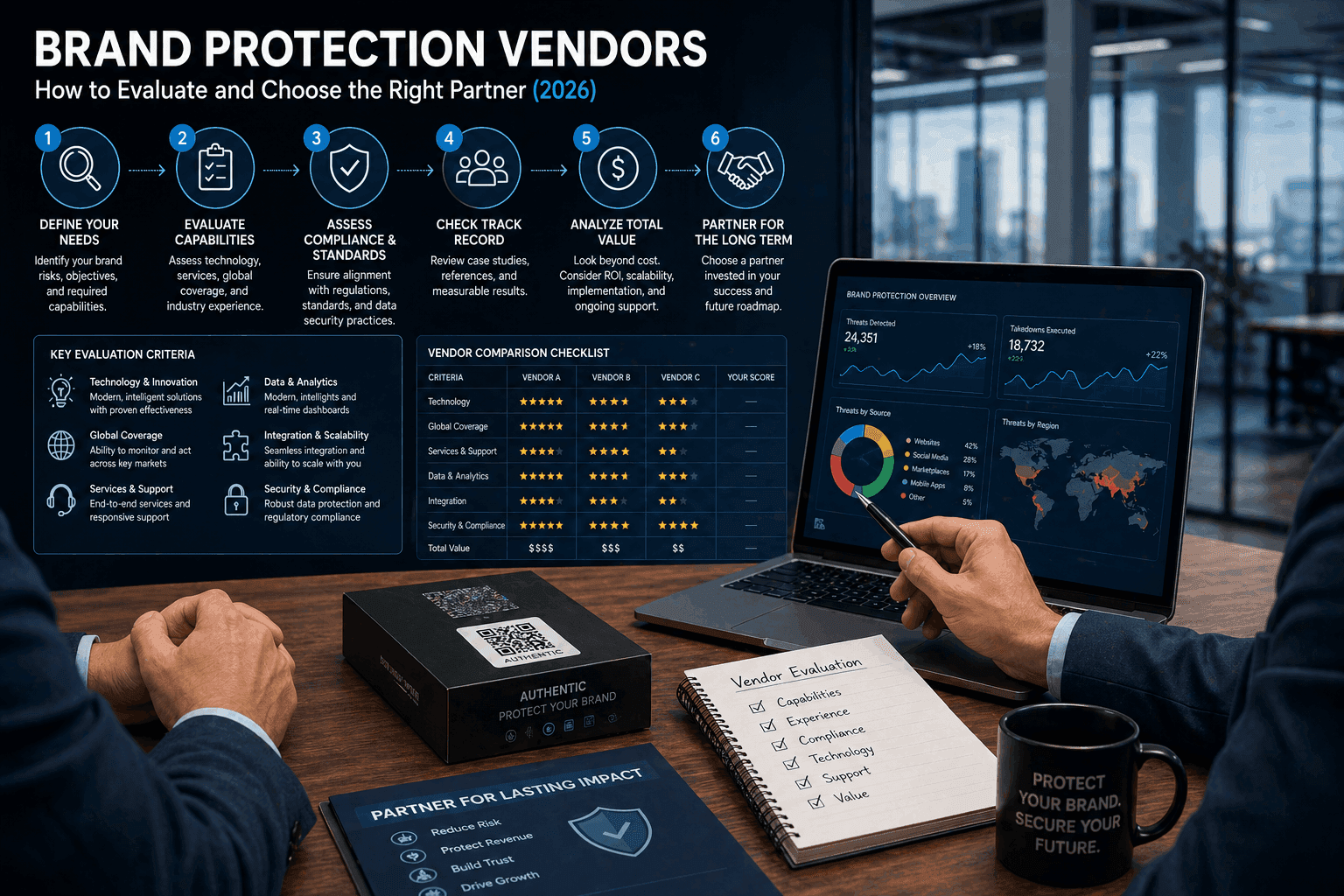
The brand protection vendor market is crowded, technically diverse, and full of conflicting claims. Vendors offering holograms, QR authentication, track and trace software, digital watermarking, and AI-powered monitoring all use similar language — "comprehensive protection," "end-to-end solution," "proven at scale" — making meaningful comparison genuinely difficult.
This guide cuts through the noise. It explains what each category of brand protection vendor actually does, what questions to ask during evaluation, what red flags to watch for, and how to structure a shortlisting process that results in a partnership that holds up under real-world threat conditions.
According to the EUIPO, EU industries lose more than €83 billion annually to counterfeiting. The WHO estimates 1 in 10 medical products in lower-income markets is substandard or falsified. Choosing the wrong vendor does not just waste budget — it leaves your brand and your customers exposed.
What Brand Protection Vendors Actually Do
Brand protection vendors provide technologies, platforms, or services that help organisations detect, prevent, or respond to counterfeiting, diversion, and brand abuse. The key distinction is that "technologies, platforms, or services" are fundamentally different value propositions that often get bundled under the same label.
A vendor selling holographic labels delivers a physical product requiring sourcing, inventory management, and eventual replacement when counterfeiters catch up. A vendor selling track and trace software delivers a platform requiring integration, data governance, and ongoing management. A vendor selling enforcement services delivers human expertise requiring ongoing relationship management.
Understanding which category a vendor falls into — and whether that category matches your primary need — is the first filter in any evaluation. Read the brand protection software evaluation guide for a detailed framework before entering any vendor conversation.
The Five Brand Protection Vendor Categories
1. Physical Security Feature Vendors
These vendors supply overt and covert physical security features: hologram stickers, UV security inks, tamper-evident seals, colour-shifting inks, and security threads. Their products are integrated into packaging during production.
Strengths: Low unit cost, proven supply chains, widely understood by packaging teams. Weaknesses: Overt features can be replicated by sophisticated counterfeiters within months. Covert features require detection equipment that limits field verification to trained personnel. No analytics or reporting capability — verification is pass/fail with no data generated. Best suited for: First-level deterrence in low-to-medium counterfeit-risk markets, or as one layer within a multi-layer protection architecture.
2. Digital Authentication Vendors
These vendors link physical products to digital records via QR codes, NFC tags, RFID, or barcodes. Verification happens by scanning the code and querying a central database. Platforms typically include scan analytics and geographic reporting.
Strengths: Consumer-accessible verification (any smartphone), real-time reporting, scan analytics enable market intelligence. Weaknesses: Codes can be cloned — a counterfeiter who captures a valid serial number can reproduce it on fake packaging. Database integrity depends on strict serialisation management and anomaly detection. Best suited for: Consumer engagement programmes combined with brand protection, supply chain serialisation, regulatory compliance tracking.
3. Cryptographic and Invisible Authentication Vendors
These vendors embed unforgeable cryptographic signals into packaging artwork or materials. Unlike QR codes, cryptographic marks cannot be replicated without the private key. Invisible authentication hides the signal within the existing artwork — no visible label change — while verification happens via smartphone app. Smart packaging integration enables real-time intelligence from every scan event.
Strengths: Mathematically resistant to replication regardless of counterfeit sophistication. No visible feature to study or clone. Implementation within existing printing process minimises production disruption. Weaknesses: Requires consumer or field team awareness of the verification mechanism. Less immediately visible to end consumers than overt features. Best suited for: High-value products in markets with sophisticated counterfeiting networks — pharmaceuticals, premium FMCG, automotive parts, electronics.
4. Track and Trace Software Vendors
These vendors provide platforms that log product movements through the supply chain using serialised identifiers. Track and trace is mandated by regulation in pharmaceuticals (FDA DSCSA) and increasingly required in other sectors.
Strengths: Supply chain visibility at scale, regulatory compliance support, diversion detection through pattern analysis. Weaknesses: Track and trace monitors where products should be — it does not authenticate what products physically are. Serial number duplication attacks can pass through without triggering alerts unless product-level authentication is also in place. Best suited for: Regulated industries with serialisation mandates. See the pharmaceutical serialisation guide for the deepest treatment of this category.
5. Brand Monitoring and Enforcement Vendors
These vendors monitor digital channels — marketplaces, social media, grey market platforms — for brand abuse and counterfeit listings. Some also provide takedown services and enforcement coordination with customs agencies.
Strengths: Addresses the growing threat of online counterfeit sales, provides intelligence on where fake products are being distributed. Weaknesses: Reactive by nature — monitoring detects existing counterfeiting rather than preventing it. Does not address physical product authentication at point of sale. Best suited for: Organisations with significant e-commerce exposure or premium brands that attract high-volume counterfeit listings on marketplaces.
Seven Questions to Ask Every Brand Protection Vendor
1. How does your technology perform against a sophisticated counterfeiter with six months to study it?
This exposes replication resistance over time — the most important long-term performance metric. Overt features typically degrade in resistance within 12–18 months in active markets. Cryptographic features remain resistant indefinitely. Vendors who cannot answer this question with specificity are selling a feature checklist, not a protection strategy.
2. What does a verification event look like in the field?
Ask for a live demonstration in realistic field conditions — not a controlled environment. Verification that works in a lab but requires specialist equipment or stable internet will fail when you need it most. Mobile verification operating on standard smartphones with no app download requirement should be the baseline expectation.
3. What data do you generate, and how is it surfaced?
Passive anti-counterfeit technologies generate no data. Digital and cryptographic technologies generate scan-level data. Ask specifically: can you see a single serial number being scanned 200 times across three countries in 48 hours? This is the signal that catches sophisticated counterfeiting operations. Vendors who cannot show live anomaly detection are selling compliance, not intelligence.
4. What is the implementation impact on my production process?
New security features requiring new materials, equipment, or significant packaging redesign carry hidden costs and timelines. Ask for implementation case studies from production environments comparable to yours in scale and complexity.
5. How does your solution handle serial number cloning or code duplication?
If the answer is not detailed — including specifics about duplicate scan detection, geographic anomaly flagging, and response workflows — the platform is vulnerable to a fundamental attack vector that organised counterfeit networks actively exploit.
6. What are your reference deployments in similar industries and threat environments?
Case studies on vendor websites are curated. Ask for references you can contact directly in your industry and geography. Specifically ask: has the technology been tested against an organised counterfeit operation, and what happened?
7. What does the total cost of ownership look like over three years?
Three-year TCO includes packaging redesign, production integration, staff training, detection equipment, database or platform licensing, and ongoing analytics access. The business case for brand protection solutions provides a framework for modelling TCO against quantified risk exposure.
Red Flags in Brand Protection Vendor Evaluations
No specifics on replication resistance — vague references to "military-grade" or "patent-protected" without explaining why the technology cannot be replicated
No analytics capability — the solution is passive with no data generated from verification events
Reference customers only in low-threat markets — tells you little about real-world performance
Implementation requires full packaging redesign — added risk and cost vendors often minimise in proposals
Long-term lock-in with proprietary data formats — makes switching vendors or integrating with supply chain partners costly
No explanation of what happens when a counterfeiter studies the technology
What a Multi-Layer Brand Protection Architecture Looks Like
The most effective brand protection deployments layer complementary capabilities: product-level authentication (cryptographic invisible authentication verifiable by smartphone), supply chain visibility (track and trace serialisation flagging distribution anomalies), market monitoring (online monitoring for counterfeit listings), and consumer engagement (mobile verification that turns authentication into a touchpoint).
The brand protection solutions overview describes how these layers work together in integrated deployments across pharmaceutical, FMCG, and automotive sectors. The solutions for pharmaceuticals, FMCG, and automotive each describe how the architecture adapts to sector-specific threat profiles.
How to Shortlist Brand Protection Vendors in Four Steps
Step 1: Define your primary threat
Is your primary threat organised counterfeiting at manufacturing scale, supply chain diversion, grey market distribution, or online marketplace abuse? The answer determines which vendor category addresses your core need. Buying monitoring software when your problem is sophisticated factory fakes will not solve the problem.
Step 2: Map your verification environment
Who needs to verify, where, and with what equipment? Consumer verification requires mobile-first, no-download solutions. Field inspector verification can support app-based tools. Automated supply chain verification requires integration with warehouse management and ERP systems.
Step 3: Pilot in your production environment
Require a production-environment pilot before commercial commitment. Test: implementation complexity on your actual production line, verification success rate in realistic field conditions, and quality of analytics from scan data. Do not accept a controlled demonstration as validation.
Step 4: Model three-year total cost of ownership
Compare vendors on TCO, not unit cost. The CFO ROI guide provides the financial modelling framework your finance team will need to approve the investment.
Frequently Asked Questions
How many brand protection vendors should I evaluate?
Three to five vendors is the practical range for a rigorous evaluation. Fewer than three limits your comparison baseline. More than five creates evaluation fatigue and rarely surfaces meaningfully different options given how few vendors operate at genuine commercial scale with validated field deployments.
Should I use a single vendor or multiple vendors for brand protection?
Multi-layer protection architectures typically involve more than one vendor — for example, a product authentication vendor combined with a track and trace platform and a monitoring service. The key is ensuring the layers integrate effectively and data flows between them. Some vendors offer end-to-end platforms that combine authentication, serialisation, and analytics in one system.
How long does brand protection vendor implementation take?
Physical label solutions can be deployed within a production development cycle (8–16 weeks). Digital authentication platforms typically require 3–6 months for production integration. Invisible cryptographic authentication operating within existing artwork often has shorter timelines because it does not require packaging redesign.
What industries have the most developed brand protection vendor ecosystems?
Pharmaceuticals has the most mature vendor ecosystem, driven by regulatory mandates from FDA DSCSA, EU FMD, and equivalent global frameworks. FMCG, luxury goods, and automotive have growing ecosystems driven by commercial counterfeiting losses. Electronics and agrochemicals are sectors where vendor capability is expanding rapidly as counterfeit threats intensify.
Conclusion: The Right Vendor Matches Your Threat
Brand protection vendor selection is a strategic decision that determines how effectively your brand, supply chain, and customers are protected over a multi-year horizon. The vendor with the most impressive technology is not necessarily the right partner — the right partner addresses your specific threat profile, integrates with your production environment, and generates the intelligence you need to stay ahead of counterfeit networks as they adapt.
Start with your threat. Then map your verification environment. Then evaluate vendors against those specifics — not a generic feature checklist.
Talk to Ennoventure about your brand protection requirements →
FAQs
Can a product have both tamper evidence and authentication?
Yes, and for brands facing multiple threat types, both are appropriate. Tamper evidence addresses retail interference and regulatory compliance; authentication addresses manufactured counterfeiting and diversion. They solve different problems and coexist on the same pack without interference.
Is a QR code product authentication?
A standard QR code is not authentication — it is a link to a URL. Anyone can generate a QR code linking to any page, including a fake verification page. A serialised QR code with a unique code per pack gets closer, but serial numbers can be copied from genuine packs onto fakes. Cryptographic authentication embedded in the pack — not printed on its surface as a scannable code — is what makes verification forgery-proof.
Does pharmaceutical serialisation provide product authentication?
Serialisation under FMD and DSCSA verifies the serial number is valid and was assigned to a product of that type. It does not verify the physical pack is genuine — only that the credential on it is legitimate. A valid serial number can be copied onto a falsified pack. Physical authentication is a separate layer that addresses this gap.
How does invisible authentication work?
A cryptographic signature is generated using a private key and embedded in the pack artwork during the print process — not as a separate component but as part of the image. A smartphone camera reads the embedded signature and a server verifies it against the expected value generated by the corresponding public key. If the signature is valid, the pack is genuine. If not — because the pack is a fake without access to the private key — the verification fails. There is nothing on the surface to copy because the signature is not visible.
What is the cost difference between tamper evidence and authentication?
Tamper evidence costs per unit — label material, adhesive, application. At high volumes, standard VOID labels are very cost-effective. Authentication using embedded invisible signatures costs at the artwork level — it is an artwork change that applies to an entire print run, not a per-unit addition. At FMCG scale, this makes cryptographic authentication cost-competitive with physical label additions while providing significantly greater security.