Best Anti-Counterfeit Solution: A Complete Buyer's Guide for 2026
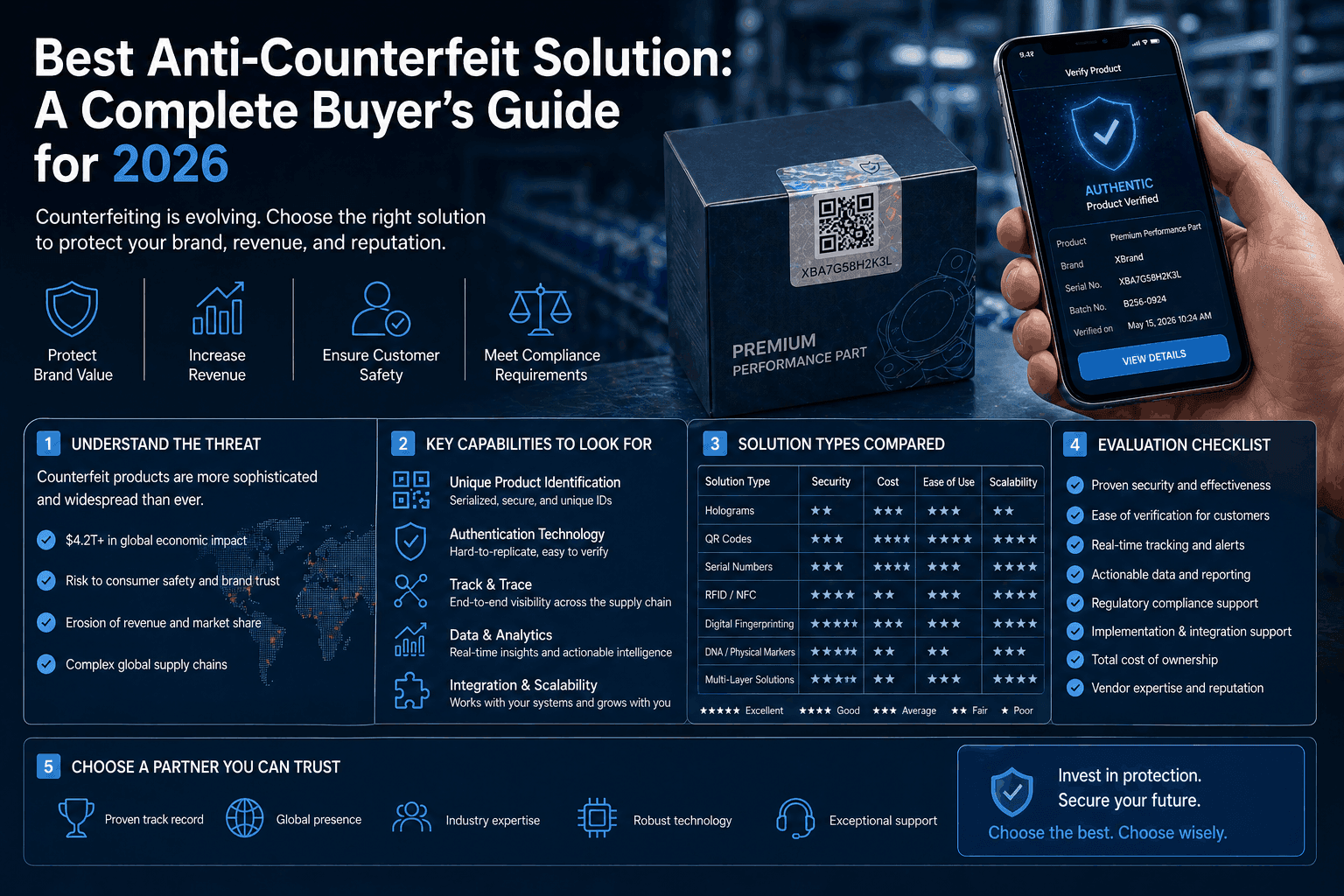
Finding the best anti-counterfeit solution is not a question of picking the most technologically impressive product. It is a question of matching the right protection mechanism to your product category, supply chain complexity, regulatory environment, and threat profile. Get that match wrong and you spend budget on security theatre — features that look robust in a sales presentation but fail in the field.
This guide covers the five main technology categories, how to evaluate them objectively, and what leading brands in pharmaceuticals, FMCG, and automotive are actually deploying in 2026.
According to the OECD, trade in counterfeit and pirated goods reached $464 billion annually — roughly 2.5% of world trade. The EUIPO estimates EU industries alone lose €83 billion per year to counterfeiting. These are not abstract figures — they represent real revenue loss, real patient harm, and real brand erosion happening to companies across every sector.
Why the Best Anti-Counterfeit Solution Depends on Context
There is no single best anti-counterfeit solution that works equally well for a pharmaceutical blister pack, a can of premium lubricant, and an automotive brake pad. The effectiveness of any anti-counterfeiting technology depends on four variables: where counterfeiting occurs (at manufacturing, in the supply chain, or at retail), who needs to verify (field inspectors, consumers, border agents, or automated systems), what the counterfeit looks like (low-quality fakes versus near-perfect replicas with cloned codes), and what your production line can accommodate.
The starting point is understanding your counterfeit detection needs in full before evaluating any vendor.
The Five Main Anti-Counterfeit Technology Categories
1. Overt Features: Holograms and Security Labels
Overt features are visible to the naked eye and designed to signal authenticity at a glance. Hologram stickers and colour-shifting inks are the most widely used. They are low-cost and easy to apply.
The critical limitation: overt features are publicly visible, which means counterfeiters can study, replicate, and eventually source convincing fakes. In mature counterfeit markets, holographic labels are often cloned within months of introduction. Overt features remain valuable as a first layer but should never be the only layer for high-risk products.
2. Covert Features: UV Inks and Forensic Markers
Covert features are invisible under normal conditions and require a specific tool or light source to detect. UV security inks, chemical taggants, and DNA markers are all examples. Covert features are harder to replicate than overt ones because counterfeiters cannot examine what they cannot see. The trade-off is verification complexity — field teams need detection equipment, limiting consumer-facing verification. Covert features work best for supply chain and trade-channel verification rather than end-consumer authentication.
3. Digital Authentication: QR Codes and Serialisation
Digital authentication links a physical product to a digital record via a unique code — typically a QR code, barcode, or NFC tag. When scanned, the code queries a database and returns an authenticity result. Digital authentication offers three advantages covert features do not: real-time reporting, scan analytics, and consumer engagement. The challenge is code cloning — a counterfeiter who captures a legitimate serial number can reproduce it on fake packaging. Track and trace systems add supply chain event logging to strengthen digital code integrity against duplication attacks.
4. Cryptographic and Invisible Authentication
Cryptographic authentication embeds an unforgeable signal — generated by a cryptographic algorithm — directly into the packaging artwork or material. Unlike a QR code that can be copied, a cryptographic mark cannot be replicated without knowing the private key used to generate it.
Invisible authentication takes this further by hiding the cryptographic signal within the existing artwork — no visible label, no hologram, no change to the packaging design visible to a counterfeiter. Verification happens via a standard smartphone. Because the signal is generated per-unit and mathematically verifiable, there is no database of codes to steal and no visible feature to clone. This makes cryptographic invisible authentication the hardest category to defeat and the most appropriate choice for products facing sophisticated, well-resourced counterfeit networks.
5. Track and Trace Systems
Track and trace does not prevent a counterfeit from being made — it tells you where a product should be and flags when a product appears where it should not. Pharmaceutical track and trace systems mandated by regulations like FDA DSCSA are the most developed examples. Track and trace works best as a supply chain layer that complements product-level authentication. Read the full pharmaceutical serialisation and track and trace guide for a deeper breakdown.
Five Criteria for Evaluating Any Anti-Counterfeit Solution
1. Replication Resistance Over Time
Ask every vendor: what happens when a counterfeiter studies your technology for six months and tries to replicate it? Overt features typically fail this test within 12–18 months in active counterfeit markets. Covert features offer more resistance. Cryptographic features are mathematically resistant regardless of exposure time — there is no observable feature to reverse-engineer.
2. Verification Accessibility
Who needs to verify, and with what equipment? If the answer includes consumers with standard smartphones, the solution must support mobile verification without a dedicated reader. Solutions requiring specialised equipment limit verification to trained personnel and exclude the consumer verification layer that generates the most intelligence.
3. Supply Chain Integration Complexity
How much does implementation change your production process? Solutions requiring new printing lines, specialised inks, or significant packaging redesigns carry hidden costs. Ask for implementation timelines from comparable production environments, not just reference case studies.
4. Analytics and Reporting
Passive anti-counterfeit technologies — features that authenticate but generate no data — cannot tell you how often products are being verified, where fake products are surfacing, or which distribution channels carry the highest risk. Digital and cryptographic technologies generate scan data that becomes an intelligence asset. The latest trends in anti-counterfeiting technology show that intelligence capability is now the primary differentiator between leading and lagging solutions.
5. Total Cost of Ownership
Vendor proposals focus on unit cost per label or implementation fee. Total cost of ownership includes: packaging redesign, production line modification, staff training, detection equipment for field teams, and ongoing licensing or database fees. The CFO's guide to brand protection solution ROI provides a full TCO framework with industry benchmarks.
Industry-Specific Guidance
Pharmaceuticals
Pharmaceutical counterfeiting carries patient safety consequences that no other product category faces. The pharmaceutical sector requires the highest level of protection: serialisation for regulatory compliance plus a product-level authentication layer that survives sophisticated clone attacks. WHO estimates 1 in 10 medical products in lower-income markets is substandard or falsified — and sophisticated fakes are increasingly reaching high-income supply chains. The combination of track and trace plus cryptographic invisible authentication represents the current standard of care for premium and speciality pharmaceuticals.
FMCG and Consumer Goods
The FMCG sector faces high-volume counterfeiting targeting premium-priced SKUs — food, personal care, spirits, and agrochemicals. Consumer-facing verification that does not require a dedicated app maximises adoption. Invisible authentication embedded in existing packaging artwork allows brands to add protection without changing the consumer-facing design or adding visible security features that signal insecurity rather than quality.
Automotive Aftermarket
Counterfeit automotive parts — brake pads, filters, bearings — create direct safety risks and erode dealer trust. The automotive aftermarket typically relies on multi-tier distribution networks where verification needs to happen quickly at the dealer or installer level. Solutions that enable instant smartphone verification without specialist equipment align with how automotive service environments actually operate. The automotive anti-counterfeiting guide covers the threat landscape in depth.
What Separates Genuine Protection from Security Theatre
The market for anti-counterfeit solutions is filled with products that look credible in a presentation but fail operationally. Signs of security theatre: no published data on how long the technology has resisted replication in active markets; verification requires specialist equipment unavailable in field conditions; no scan analytics or reporting capability; implementation requires significant packaging redesign with no ROI timeline provided; reference customers are all in low-counterfeit-risk categories.
Genuine protection provides: mathematically verifiable authentication, a mobile-first verification interface, real-time scan data, and documented performance in high-risk counterfeit environments. Product verification at the unit level — not just the batch or pallet level — is the standard that separates credible solutions from cosmetic ones.
Frequently Asked Questions
What is the most secure anti-counterfeit solution available?
Cryptographic invisible authentication is currently the hardest category to defeat because it embeds a mathematically verifiable signal that cannot be replicated without the private key. Unlike QR codes or holograms, there is no visible feature to copy and no database of codes that can be stolen. For pharmaceutical and high-value consumer products, combining cryptographic authentication with track and trace creates the strongest protection architecture.
How much does anti-counterfeit solution implementation cost?
Costs vary widely by technology type and production environment. Holographic labels start at fractions of a cent per unit but require sourcing from secure suppliers. Digital authentication with analytics platforms typically involves per-unit licensing plus implementation fees. Invisible authentication solutions often have lower per-unit costs than physical labels because they operate within existing artwork without additional materials. Always model total cost of ownership before comparing vendor proposals on unit cost alone.
Can consumers verify product authenticity themselves?
Yes — with digital and cryptographic authentication technologies. QR codes and NFC tags can be scanned with any smartphone camera to return an authenticity result. Mobile verification platforms designed for consumer use do not require a dedicated app and return a clear pass/fail result in under three seconds. For maximum consumer participation, the verification interface should be accessible via standard browser without download friction.
Do I need track and trace if I already have product authentication?
Both serve different purposes and work best together. Product authentication tells you whether the product in hand is genuine. Track and trace tells you where the product should be at each supply chain stage. Track and trace without product authentication leaves you vulnerable to code cloning. Product authentication without track and trace misses supply chain anomalies indicating systematic diversion. The combination provides closed-loop protection at both the unit and supply chain level.
How long does anti-counterfeit implementation take?
Simple label-based solutions can be introduced within a product development cycle (8–16 weeks). Digital authentication platforms typically require 3–6 months for production integration. Cryptographic invisible authentication, because it operates within the existing printing process, often has shorter implementation timelines than digital label solutions and does not require packaging redesign.
Conclusion: Match the Solution to the Threat
The best anti-counterfeit solution is the one that matches your specific threat profile, verification environment, and production constraints — not the one with the most impressive technical specification. Start with an honest assessment of where your products are being counterfeited, who needs to verify authenticity, and what your production line can accommodate without a costly overhaul.
For most pharmaceutical, FMCG, and automotive brands operating in markets with active counterfeit networks, the answer increasingly points toward invisible cryptographic authentication — technology that requires no visible packaging change, generates real-time intelligence, and cannot be replicated by studying the packaging surface.
FAQs
Can a product have both tamper evidence and authentication?
Yes, and for brands facing multiple threat types, both are appropriate. Tamper evidence addresses retail interference and regulatory compliance; authentication addresses manufactured counterfeiting and diversion. They solve different problems and coexist on the same pack without interference.
Is a QR code product authentication?
A standard QR code is not authentication — it is a link to a URL. Anyone can generate a QR code linking to any page, including a fake verification page. A serialised QR code with a unique code per pack gets closer, but serial numbers can be copied from genuine packs onto fakes. Cryptographic authentication embedded in the pack — not printed on its surface as a scannable code — is what makes verification forgery-proof.
Does pharmaceutical serialisation provide product authentication?
Serialisation under FMD and DSCSA verifies the serial number is valid and was assigned to a product of that type. It does not verify the physical pack is genuine — only that the credential on it is legitimate. A valid serial number can be copied onto a falsified pack. Physical authentication is a separate layer that addresses this gap.
How does invisible authentication work?
A cryptographic signature is generated using a private key and embedded in the pack artwork during the print process — not as a separate component but as part of the image. A smartphone camera reads the embedded signature and a server verifies it against the expected value generated by the corresponding public key. If the signature is valid, the pack is genuine. If not — because the pack is a fake without access to the private key — the verification fails. There is nothing on the surface to copy because the signature is not visible.
What is the cost difference between tamper evidence and authentication?
Tamper evidence costs per unit — label material, adhesive, application. At high volumes, standard VOID labels are very cost-effective. Authentication using embedded invisible signatures costs at the artwork level — it is an artwork change that applies to an entire print run, not a per-unit addition. At FMCG scale, this makes cryptographic authentication cost-competitive with physical label additions while providing significantly greater security.