Counterfeit Monitoring Tools: What Actually Works in 2026
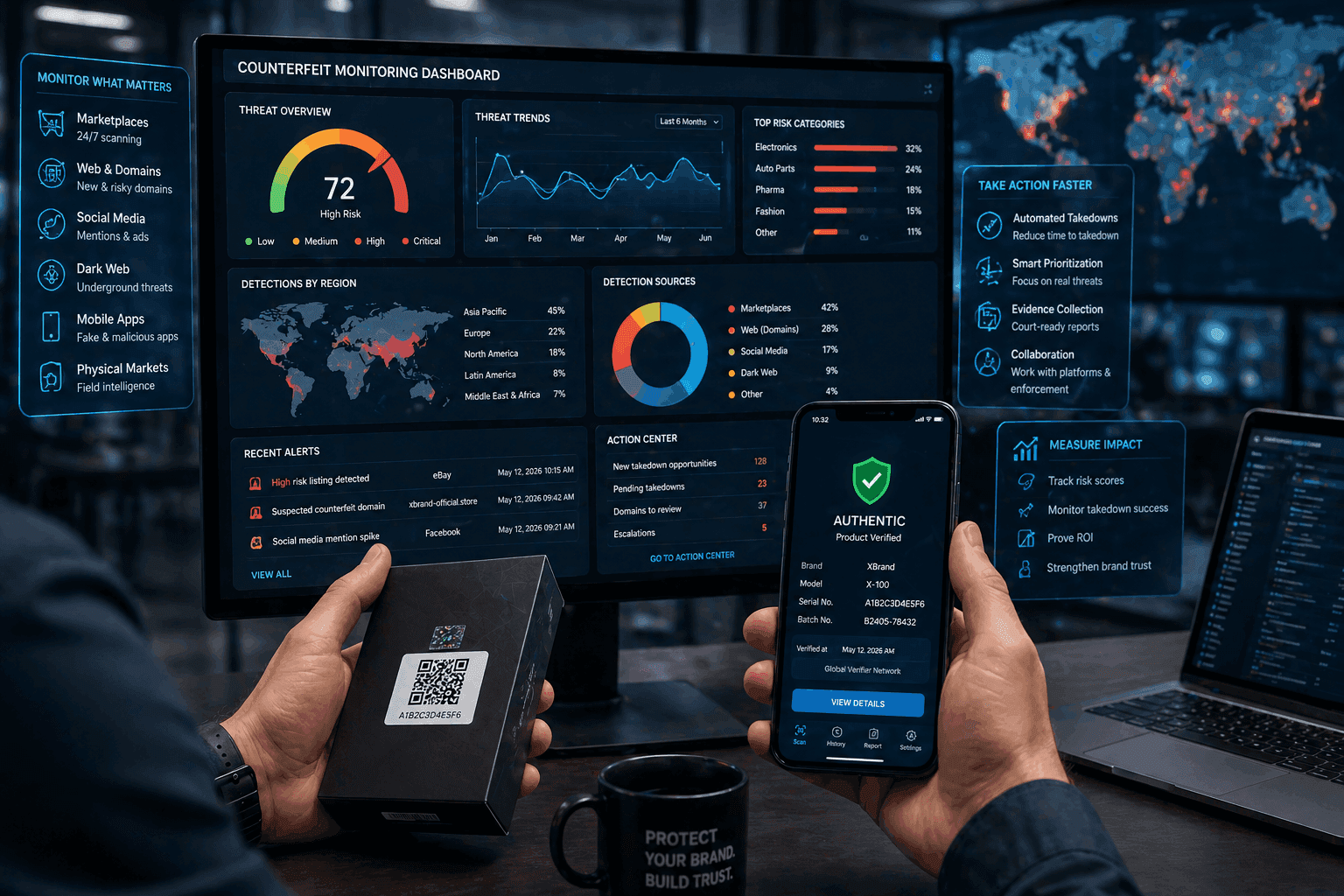
Counterfeit monitoring tools have proliferated rapidly over the last five years. AI-powered marketplace crawlers, social media monitoring platforms, brand intelligence dashboards, and real-time scan analytics now all compete for the same line item in brand protection budgets. Most brands are using at least one of them. Most brands are also discovering that monitoring alone does not stop counterfeits from reaching customers.
This guide explains what each type of counterfeit monitoring tool actually does, what data you need to make monitoring actionable, and how to build a monitoring strategy that does more than generate reports.
The scale justifies the investment: OECD research estimates global trade in counterfeit goods at $464 billion annually. Interpol regularly intercepts counterfeit shipments across every product category. The question is not whether monitoring matters it is whether your monitoring setup is generating intelligence you can actually act on.
Why Counterfeit Monitoring Is Not Optional
The counterfeit market has migrated significantly online. Third-party marketplace listings, social media storefronts, messaging app networks, and grey market platforms now represent the primary distribution channel for fake goods in most product categories. Without counterfeit monitoring tools scanning these channels continuously, fake products selling under your brand name can reach thousands of consumers before your team is aware they exist.
Counterfeit detection at the digital level also provides intelligence that physical authentication alone cannot: where fake products originate, which platforms carry the highest volumes, which geographic markets face the most acute threat, and which product lines attract the most organised counterfeiting attention. The covert authentication layer at the product level and the monitoring layer at the market level are complementary neither replaces the other.
The Four Main Types of Counterfeit Monitoring Tools
1. Online Marketplace Monitoring
Marketplace monitoring tools crawl major e-commerce platforms Amazon, Alibaba, eBay, Lazada, Shopee, and regional equivalents scanning listings for brand name misuse, suspicious seller behaviour, and counterfeit product indicators. More sophisticated tools use image recognition to flag visually similar but counterfeit listings even when sellers avoid using the brand name directly.
What they detect well: High-volume counterfeit sellers, systematic use of brand names and imagery in fake listings, geographic concentration of counterfeit distribution.
What they miss: Private marketplace channels, social media direct selling, messaging app networks (WeChat, Telegram, WhatsApp commerce), and grey market distribution through legitimate-looking wholesale accounts.
Key data outputs: Number of infringing listings, seller profiles, listing velocity, price undercutting data, geographic distribution of fake sellers.
2. Social Media and Dark Web Monitoring
Social media monitoring tools track brand mentions, hashtags, and image use across platforms — Instagram, TikTok, Facebook, Twitter, and others — to identify counterfeit sellers using social channels for promotion and sales. Some platforms also scan dark web marketplaces where wholesale counterfeit distribution is coordinated.
What they detect well: Social commerce counterfeit storefronts, influencer promotion of fake products, emerging distribution channels before they scale.
What they miss: Encrypted communications where deals are coordinated, physical-world distribution of counterfeits, in-store or street market fake product sales.
Key data outputs: Influencer accounts promoting fakes, social platform seller profiles, content removal candidates, emerging platform threats.
3. Physical Supply Chain Monitoring
Supply chain monitoring tools use serial number tracking and track and trace systems to log product movements through distribution tiers and flag anomalies. A product scanned in two geographically distant locations within an impossible time window signals serial number duplication. A product appearing in an unauthorised distribution channel signals diversion.
What they detect well: Serial number cloning, supply chain diversion, grey market routing of legitimate products, inventory discrepancies indicating product leakage.
What they miss: Counterfeits that carry no traceable identifier, online distribution of fakes, and post-sale counterfeiting that bypasses the monitored supply chain entirely.
Key data outputs: Anomalous scan events, geographic distribution discrepancies, unauthorised channel appearances, duplicate serial number events.
4. Real-Time Product Authentication Analytics
Authentication analytics tools aggregate data from consumer and field verification events every time someone scans a QR code, taps an NFC tag, or verifies a product via app into a real-time intelligence dashboard. Anomaly patterns reveal where fake products are being distributed: a spike in failed verifications in a specific city indicates fake products entering that market. A serial number scanned 500 times across three countries in 48 hours indicates systematic counterfeiting using cloned codes.
What they detect well: Geographic concentration of counterfeiting, specific product lines or SKUs being targeted, retail channels carrying fake products, timing patterns in counterfeit distribution.
What they miss: Counterfeiting of products that carry no authentication mechanism, dark markets where fake products are sold without any verification attempt.
Key data outputs: Verification success rates by geography and SKU, anomaly alerts on duplicate or impossible scan patterns, market-level threat heatmaps, enforcement intelligence packages.
What Data You Actually Need From Counterfeit Monitoring Tools
Most brands are data-rich and action-poor when it comes to counterfeit monitoring. Dashboards accumulate reports. Reports generate meetings. Meetings produce takedown requests that address individual listings without disrupting the underlying distribution network. The data that actually enables action is more specific than most monitoring tools natively provide.
Seller Network Mapping, Not Just Listing Counts
A single organised counterfeiting operation may run dozens of marketplace accounts. Listing counts tell you how many fake listings exist. Seller network mapping tells you how many distinct operations are behind them and which accounts are connected through shared pricing patterns, image libraries, or fulfilment locations. Enforcement against a network is orders of magnitude more effective than takedowns of individual listings.
Geographic Threat Intelligence
Where are fake products concentrated? Which markets face the highest exposure? Geographic data at the city or region level not just the country level — enables targeted field enforcement. The US Customs and Border Protection and EUIPO enforcement databases can supplement your monitoring data with seizure intelligence that maps to your brand's geographic exposure.
Trend Data and Velocity Metrics
Is the volume of counterfeit activity increasing or decreasing? Are specific product lines being newly targeted? Trend data over time reveals whether your enforcement actions are suppressing counterfeit networks or whether they are adapting faster than takedowns can keep pace. Velocity metrics how quickly new counterfeit listings appear after removals are a direct measure of enforcement effectiveness.
Product-Level Authentication Intelligence
Which specific SKUs attract the most counterfeiting attention? Authentication analytics from product-level verification events identify the highest-risk SKUs. Smart packaging integrations generate this product-level intelligence automatically from every consumer or field verification event, creating a continuous signal that improves with scale.
Enforcement-Ready Evidence Packages
Monitoring data that cannot be packaged into enforcement-ready evidence is intelligence that cannot generate consequences. Counterfeit monitoring tools should output: documented listing history, seller account genealogy, product image comparisons, pricing data, and geographic distribution information in formats accepted by law enforcement, customs agencies, and marketplace trust and safety teams.
The Core Limitation of Monitoring-Only Strategies
Counterfeit monitoring tools are reactive instruments. They detect counterfeiting that is already happening and generating observable signals. By the time a fake product appears on a marketplace or triggers a failed authentication scan, it has already been manufactured, distributed, and in many cases sold to consumers.
This is not an argument against monitoring it is an argument against treating monitoring as a substitute for prevention. The most effective brand protection architectures combine monitoring (to detect and respond) with authentication (to prevent fakes from being indistinguishable from genuine products) and supply chain integrity (to prevent diversion and grey market distribution).
A brand with strong product-level authentication embedded in packaging creates a situation where every fake product that enters the market is immediately identifiable as fake the moment anyone tries to verify it generating monitoring data and removing the commercial viability of the counterfeit simultaneously. Brand protection technology that combines authentication and monitoring creates this dual function: every verification event either confirms a genuine product or flags a potential fake. The latest trends in anti-counterfeiting technology show that AI-driven detection is rapidly narrowing the window between when a counterfeit enters the market and when it is identified.
Building a Four-Layer Counterfeit Monitoring Strategy
Layer 1: Product-Level Authentication as Your Monitoring Foundation
Embed authentication at the product level covert security features, cryptographic marks, or smart packaging that generates real-time data from every verification event. This creates monitoring intelligence that originates at the product itself rather than at the distribution channel, giving earlier warning and more precise geographic intelligence than marketplace monitoring alone.
Layer 2: Supply Chain Anomaly Detection
Instrument your supply chain with track and trace serialisation that logs movement through each distribution tier. Configure anomaly detection to flag: duplicate serial number scans, products appearing outside authorised distribution channels, and scan event patterns that indicate diversion or grey market activity. Supply chain monitoring catches threats before they reach retail which is orders of magnitude cheaper than enforcement after the fact. The pharmaceutical serialisation guide covers how this layer is implemented in the most regulated sector.
Layer 3: Digital Channel Monitoring
Deploy marketplace and social media monitoring covering the platforms most relevant to your product category and geographic markets. Prioritise tools that map seller networks rather than just counting listings, and that output enforcement-ready evidence packages rather than raw data. Connect digital monitoring data to your authentication analytics a spike in marketplace fake listings that correlates with a spike in authentication failures in the same geography confirms a distribution network threat and strengthens enforcement cases.
Layer 4: Field Intelligence and Enforcement Coordination
Monitoring data that does not reach enforcement is monitoring data that does not generate consequences. Establish a response workflow that connects monitoring outputs to field inspection teams, customs intelligence sharing (through channels like Interpol's IP Crime unit), legal teams, and marketplace trust and safety contacts. The speed of response determines whether enforcement suppresses distribution networks or simply triggers them to adapt and re-emerge.
What Ennoventure's Monitoring Approach Looks Like
Ennoventure's anti-counterfeit solution generates monitoring intelligence from the product level. Invisible cryptographic authentication embedded in packaging means every scan event consumer, field inspector, or supply chain node feeds into a real-time analytics dashboard. Anomalies surface automatically: duplicate scans, geographic concentration of failed verifications, SKU-level targeting by counterfeit networks.
This approach inverts the typical monitoring dynamic. Rather than deploying external crawlers to find fake products after they enter the market, the platform surfaces intelligence from within the legitimate product's own verification activity creating a monitoring system that scales with distribution and reaches markets where external monitoring tools have limited coverage.
The mobile verification platform enables consumers and field teams to verify any product instantly, generating the scan data that powers the intelligence layer. Every legitimate verification event strengthens the baseline. Every anomalous event triggers an alert. Contact the team to see the monitoring dashboard in a live environment.
Frequently Asked Questions
Do I need multiple counterfeit monitoring tools or one integrated platform?
The answer depends on your threat profile. Brands facing high-volume online counterfeiting in multiple markets may need dedicated marketplace monitoring, social media monitoring, and authentication analytics as separate capabilities. Brands whose primary threat is supply chain diversion may get more value from deeper supply chain instrumentation than broad-coverage marketplace monitoring. The key is ensuring whatever tools you deploy generate data that is actionable not just visible in a dashboard.
How quickly can counterfeit monitoring tools detect new threats?
Marketplace crawlers typically index new listings within hours to days. Social media monitoring tools vary significantly in latency. Authentication analytics detect threats in real time the moment a fake product is scanned, the anomaly is flagged. The fastest detection systems are those closest to the product itself: authentication platforms that surface signals from verification events before fake products can scale distribution.
What is the average cost of counterfeit monitoring tools?
Costs range from a few hundred dollars per month for basic marketplace monitoring tools to six-figure annual contracts for enterprise-grade platforms covering multiple geographies and channels. Authentication analytics platforms are typically priced per unit protected rather than as a flat SaaS fee which aligns cost with the scale of deployment. Request TCO models that include implementation, integration, and analyst time alongside licensing fees.
Can AI improve counterfeit monitoring effectiveness?
Yes significantly. AI-powered image recognition identifies visually similar fake listings even when sellers avoid brand name use. Machine learning anomaly detection flags authentication scan patterns that indicate systematic counterfeiting faster than rule-based systems. Natural language processing monitors social media and messaging platforms for counterfeit promotion in local languages. The gap between AI-powered and rule-based monitoring platforms is widening rapidly in 2026.
Conclusion: Monitor to Detect, Authenticate to Prevent
Counterfeit monitoring tools are a necessary component of any brand protection strategy but they are not sufficient on their own. The most effective monitoring strategies are built on a product-level authentication foundation that generates intelligence from within the legitimate product's own verification activity, combined with supply chain instrumentation that detects diversion before it reaches retail, and digital monitoring that catches online distribution threats as they emerge.
The goal of monitoring is not to generate reports. It is to detect threats early enough to act before counterfeits reach customers and cause damage to revenue, to brand reputation, and in regulated product categories, to consumer safety.
Build your monitoring strategy around the intelligence you need to act, not the data that is easiest to collect.
Explore Ennoventure's real-time anti-counterfeit monitoring and authentication platform →
FAQs
What is the difference between Digital Brand Protection and Invisible Authentication?
Digital Brand Protection covers online surfaces — marketplaces, social platforms, forums, and news. Invisible Authentication secures the physical product and its packaging. Together they form a complete protection stack: digital intelligence flags threats, and physical authentication provides legal-grade proof.
Do I need to use both Online Brand Protection and Chirper?
Both can be used independently or as a combined Digital Brand Protection suite. Brands typically start with the surface where their risk is highest and expand as needs grow.
Which marketplaces and social platforms are covered?
Online Brand Protection covers 50+ global marketplaces including Amazon, Flipkart, Alibaba, AliExpress, Tmall, Walmart, Shopee, Lazada, Mercado Libre, JD.com, and eBay. Chirper monitors Reddit, X, news sites, forums, review sites, trade publications, and brand communities.
How quickly can threats be detected and acted on?
Marketplace takedowns are initiated within 24 hours of threat classification. Social conversation alerts arrive in under one hour from when a relevant discussion begins.
Does this require integration with our internal systems?
No technical integration is required. You provide your brand keywords, product names, and target marketplaces. Everything runs through a cloud dashboard.
Which industries does Digital Brand Protection serve?
Digital Brand Protection is built for pharmaceuticals, consumer goods, luxury, FMCG, automotive aftermarket, electronics, and specialty chemicals — industries where pricing discipline, authenticity, and brand trust are mission-critical.